Most pilots are familiar with the "CTWO+" concept... A quick briefing of important safety related factors (Charts, Terrain, Weather, Operational + Threats) before take off to ensure everyone is aware of possible issues and how we can help mitigate them...
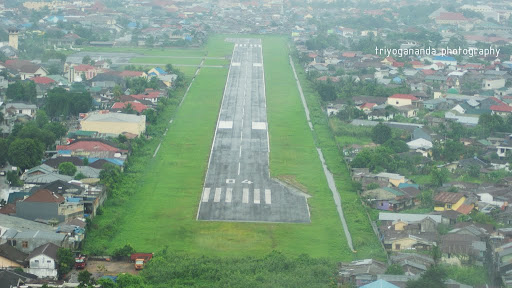
Flying in Papua makes for some interesting briefings... Here is mine from earlier this afternoon at Ilu... With a visual aid ;)
Looking "down" Runway 35 at Ilu
Chart - Runway 35 is 800m long at an elevation of 6100' with a 7% downslope...
Terrain - ummmm yeah, it's a "bit" of a factor... So an early left turn after clearing obstacles :P...
Weather - is good, not a factor.
Operationally - Max performance take off, STOL kit installed, so flaps full, rotate at 60kts, above 75kts with positive rate and clear of obstacles I'll call for flaps 20. Committal point is that shed about 100m down the runway and if we have to abort for any reason our option is to swerve into the ditch to the right, we don't go off the end. Takeoff weight is around 8000lbs, best glide will be around 91kts.
Threats - Animals and people crossing the runway, keep a good look out...
So after another couple of tours of Kalimantan, with business as usual and just as I was thinking I was becoming a permanent fixture, I got a somewhat unexpected, but pleasant, surprise in my inbox from the scheduling department...
A schedule for Papua!
Having heard plenty from other pilots about the sights, sounds and smells of Papua, I was a fairly sure I was in for a treat. I'd heard the mountain strips were "interesting", the pilots were "chilled" and that the flying was "pretty good"...
Based on my first month here, I'd say that those descriptions were huge understatements!
From the high mountain strips to the coastal lowland airfields, this place is some of the best flying I've been fortunate enough to experience.
I started my journey with a 7 hour overnight slog (once again confirming just how "wide" this country is!) from Jakarta, via Makassar, to one of the major airports in the region at Biak. Then a short hop down on a company flight to, my first Papua base, Nabire.
New base... New adventures
Nabire seems like a pretty decent place to be introduced to Papua flying, as it combines both mountain and lowland flying. So I can be flying to island strips one day... And then flying down mountain valleys the next!
Blue skies... Blue waters
We're at 10,500'... So are the mountains... And they're the small ones!
The mountain flying has certainly been a highlight. Flying into 600m long "one way" strips with 7-10% upslopes, at 6000', in a mountain valleys, with uneven surfaces and wild pigs running around makes for an interesting day at the office. Due to the challenging nature of these strips, most (for good reason) are deemed "Captain only landing" and one or two are even "Captain only takeoff"!
After visiting a couple of them... I can understand why. Visual illusions created by sloping strips, coupled with tricky winds, lots of other traffic and poor surface conditions make for a high workload.
Rocks and potholes, also known as a runway!
"Ski Jump" at Ilaga
Indeed, there are one or two "reminders" dotted about the place that Papua can be quite unforgiving if you let your guard down.
A stark reminder...
The result of a training flight (by another company) gone wrong. If you look closely you can see the damage to the wing... I was told that both wing tips actually came into contact with the ground during the incident. Thankfully, everyone walked away relatively unscathed.
Even the lowlands present their own challenges. The weather here is constantly changing and quite rapidly. Also, with a lot of runways being near to shorelines and surrounded by trees/jungle, it isn't uncommon for sea breezes to bring 10-15kt crosswinds and a fair bit of turbulence. It sure does keep you on your toes!
Black and white... At 0700hrs
Glad we were flying in the other direction!
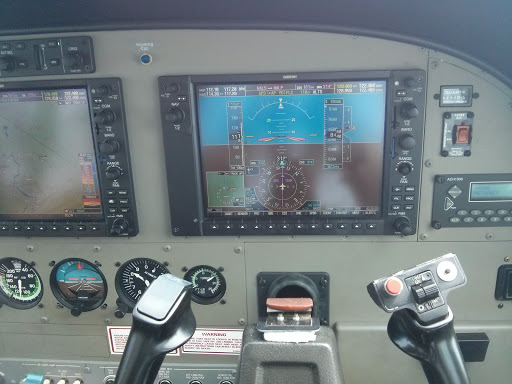
One of the less formidable challenges here, is the number of "legacy" aircraft... These aircraft don't have the fancy G1000 cockpits. Back to the "steam powered" analogue gauges with all the buttons and switches in different places. Good fun! ;-)
Rocking it "old school"
Thankfully, it isn't all work. My first week here I got the opportunity to visit some of the locals... Of the underwater variety.
What's better than one whale shark? TWO whale sharks!
Swimming with the fishes...
I think I was slightly more excited than the whale shark ;)
A truly amazing experience, that I certainly won't forget in a hurry. (As evidenced by the last photo ;-)
And electricity... Something of a luxury here in Indo...
And just to prove the point... The power just went out and the guys have turned the backup generator on! Haha...
Anyway, between the "full on" 6 day tours in northern Kalimantan, where electricity, nevermind internet access, is a "sometimes" thing... A roster that can (and does) change daily... Flights cancelled because of smog/haze caused by locals burning native forests so they can create palm oil plantation... Waiting days/weeks for government departments to issue various pieces of paper... And crazy weather that seems to follow no logical pattern... The last 6 months can be best described as "chaotic" ;)
Still... Beats sitting at a desk 9-5! :P
Some of the highlights so far:
Smashed through the 1000 hours total time, having racked up over 200 hours on the line
Had my photo taken with countless random passengers... Including ones who have just got off another airline and were just walking across the apron! ;)
Carried a 43kg "strong" box... Full of cash... That was strapped to the back of a scooter on arrival and driven away! :-/
Flew my first emergency "medivac"... An elderly gentlemen from a village in the mountains who had been shot in the abdomen with an arrow!!?!
First prisoner transport... Not exactly sure what the guy had done, but they slapped him in cuffs after he was onboard.
Carried live baby chickens...
Crossed the equator...
Strapped a woman into a separate lap and shoulder belt harness... While she was breast feeding!!?!
Had a tower controller try to vector me right through the middle of a 12 mile long wall of VERY active thunderstorms and CBs... That was within view of the tower! "Errr Negative, cannot comply due weather!"
Learnt Indonesian maths... Captain: "Max load is 980kg”... Ground crew: "thats Ok, we only have 1020kg total"... ??!?
Found a place that has decent coffee (harder than it sounds!)
Discovered that you can "shower" using wet wipes... For the record, about 20-25 should suffice...
Successfully negotiated the Indonesian banking system to get an ATM card replaced... Only took 2 visits to the bank, my passport, long stay visa, 3 forms, 5 signatures and about 6 hours of my life!
Spent more than 5 minutes in direct sunlight without burning to a crisp!
Got given a pineapple as a "thank you" gift, from one of the remote villages...
2nd best "Thank you" gift I've ever received...
Nice view from an outdoor urinal...
Basically my life for the last 6 months...
From this...
To this... In the space of 5 minutes!
Windows? We've heard of them... "Luxury" crew accommodation
Right on the profile... Right on sunset curfew! ;)
Indo airforce trainers... 2 seat Su-30's
Crossing the equator!
Zoom zoom zoom... Around 380kph!
Smoke dropped the vis to less than 2km
OSH poster boy... Fixing an aircon unit... On the 35th floor!!?!
I've been sent "on tour" to a small town, in the Northeastern region of Kalimantan, called Malinau.
Up North
My first official operational flight was a short hop from Balikpapan (WALL) to Samarinda (WALS)... Literally a postage stamp in the middle of a large city...
Easy to spot
Looks shorter than it is
Not a bad day in Samarinda
We then had a delay due to weather at our next destination, Long Ampung.
Climbing enroute to Long Ampung
Sadly, the delays meant cancelling a couple of afternoon sectors to Data Dawai and back, so we headed to Malinau instead.
I learnt a lot on my first day... Thankfully, I have been paired with a very relaxed Training Captain who is happy to answer all my questions and offer some very useful advice from his 4+ years working on the line here...
Day 2 was a little wet to start with... Some overnight storms had left their mark and there was some light drizzle and low cloud... For me, it was a half day of flying. Headed off to Tarakan (WALR) and back and then up into the middle of nowhere to a place called Long Bawan (WALB) to pick up some passengers and one prize fighting roster!!?! Before coming back to Malinau to change over with the other FO based here so he could fly the afternoon portion of the schedule.
Daily Schedule
All in all, another good learning experience... And a couple of new places visited.
And with 3.4 hours yesterday and 2.2 today... I'm now over 900 hours Total Time... 900.1 to be precise ;-) w00t!
Started out by taking a "short stroll" in 35 degree heat to a shopping mall...
About 100m from the house, I almost got run over by a guy taking driving lessons... Doing about 5km/h... Yes... Five! :P
Later on my walk, I saw a guy wearing a 'Hamas Palestine' T-shirt...
Was greeted with "Helloooo meeester" about 20 times (including 6 at once from school kids hanging out the windows of a bus and once from a guy who shouted it at me as he went past on a scooter doing about 50km/h)...
Was followed by a woman in the shopping mall... As in, down an escalator and halfway across the mall!!?! "Excuse me mister, where are you from?"... New Zealand... "Excuse me, Do you have a family?"... Yes, in New Zealand... "Do you have any kids?"... Ahhh, No... "Do you have a.... Wife?" <insert hopeful look here>... Ahhh, yes... "Meh"... <insert disappointed look and 180° turn here>... Not sure if she was going to try and set me up with herself or her daughter... :-/
Realised I've been in Indo too long when I decided that a salon asking NZ$8 for a haircut was just outrageous...
Took a taxi back to the house... Meter says 21,000... Go to pay 25,000 because I like to tip the drivers who don't mess with foreigners... gives me the 5,000 back... And asks for a 10!!?! :-/
Got a good lesson in waiting... Which is ongoing ;)
Just over a month from completing my ground course and flight training with Susi and I finally got my Indonesian license validation issued... The wheels of bureaucracy turn VERY slowly in Indo... Doesn't help when the DGCA takes a 1 week vacation to celebrate then end of Ramadan... :-/
Then, 1 day of travelling, from NZ to my first base assignment in Kalimantan, turning into 3 days due to fog in Sydney, missed connections and some admin hiccups...
Then... I get to base to find that the flight crew to aircraft ratio is a bit high...
Still, I can think of worse things than getting paid to sit around and watch TV and drink beer... :P
And here is a quick run down of things I have learned so far...
Indonesia is hot... Like ~30°C hot... ALL. THE. TIME! Morning... Afternoon... Evening... Middle of the night! The temperature variance is maybe 2 or 3 degrees...
Never trust an "Indonesian fart"... I'll spare you the details, suffice to say that imodium is very useful in this part of the world. :-/
Indonesia is cheap... Like crazy cheap... Like a big bottle of beer for $3 cheap... 30¢ for a bottle of water... Cornetto and magnum ice creams for ~80¢... $9 for tailor made pilot shirts... 1 hour cab rides that travel 30+km for $15... 3 gigs of prepay mobile data for $6...
The people are very friendly... "Hellooo Meeester"
Google Translate is awesome
Like the "Pirate Code"... I think the Indonesian road code is more a set of guidelines.... That no one follows!
Attempting to fly IFR and shoot an ILS approach from the right hand seat of a Cessna Caravan with analogue instruments and a vacuum pump failure is NOT fun
The "Engine Fire" alarm in a Cessna Caravan is VERY loud
Flying a Cessna Caravan with asymmetric flaps is hard work
Sim instructors are the same everywhere... They don't seem to be happy unless something has failed on the aircraft! :P
Sitting up until 1am watching world cup football, the night before an 8am sim session is not a good idea.
Additionally, I have been told the secret to surviving Indo is to remember 2 simple rules:
Nothing makes sense
Don't get too personally invested in anything
To elaborate slightly... With regards to rule #1... There doesn't seem to be any logic or order in Indo's brand of chaos... Once you make peace with this fact, you'll quickly stop asking questions that contain the word "why"... And you'll be a much happier person...
As for rule #2... Trying to achieve anything, is a constant battle... Trying to effect change is nigh on impossible... If you invest yourself to heavily in something, chances are very high that you will ultimately end up very frustrated and/or angry...
I've only been here 2 weeks and already I can see the benefits of Rule #1... I suspect that trying to figure out the "why's" of Indonesia would be a lifetime of work... (And would most probably just end up proving Rule #2! :-P)
Having said all that, I'm having a blast... I've got a good bunch of guys on my training intake... Pangandaran is beautiful little beach resort... The training schedule is intense but the content is interesting...
The only real downside is that the Lovely Em is all the way back in New Zealand... :( Fingers crossed I get a few days off after training is completed for a quick trip back to NZ!
Can't wait to get into the real aircraft next week... After the written and verbal exams are done! :-P