Monday, 24 August 2009

When you least expect it...

Saturday morning saw me drag my butt out of bed at ridiculous o'clock to drive down to Hamilton for a sim session with Trevor (and the promise of a ride in the back of the Twin Comanche, DOK)...

In typical fashion, the only thing that occurred according to plan was that we drove to Hamilton and back :P

It turned out that the twin was booked most of the day by someone else. So John, Trevor's Instructor, decided we would do a quick session in the Sim and then we would take the nice "new" Archer III, WIT, for a ride so Trevor could familiarise himself with the cockpit instruments as it has the same "glass" instruments as the Twin Comanche.

While we were at it, John decided Trevor would fly us Matamata and they'd play with all the fancy pants equipment like the 3-axis autopilot, dual Garmin 430's and the Aspen Avionics EFD1000, then we'd swap over and I could take him for some circuits and do some stalls and a forced landing etc. on the way back to Hamilton and thus get "checked to line" for Waikato Aero Club purposes.

So my cruisy day of sitting in the sim and the backseat watching proceedings quickly turned into a $200+ mini-checkride :-/

So while Trevor and John finished up in the sim, I went out and pre-flighted WIT.
There are more excellent photo's that Chris has taken over on his blog here and here. Note that these pics were taken before the avionics upgrade. You can see a demo of the Aspen EFD1000 here.

The aircraft is still in pretty good nick... it even has that nice "new car leather" smell... Ooooo Shiny! ;) My only complaints are that there isn't enough room in the back (I couldn't wear my normal headset as I simply didn't have enough headroom!! So I had to resort to my homemade headset that wraps around the back) and because of the auto-pilot, the controls are quite "heavy" as the controls are all run through servo's. Other than that, the machine is a real dream!

The "check-ride" actually went pretty well... although due to an impromptu airshow being conducted at Matamata by a homebuilt scaled-down Fockewolfe FW-190, ZK-FWI our plan for circuits ended up being the stalling and forced landing component of the ride which went pretty well, although I got a little wide on the forced landing due to the longer wing on WIT compared with LMA, so my visual references using the wing-tip to judge spacing was a bit out. To my credit I did pick up on it and corrected it as best I could.

We came back and landed at Matamata to pick up Trevor and then headed back to Hamilton to finish up for the day and head back to Auckland.

So, not quite the day we had planned, but I think it turned out pretty well... and I have finally flown an aircraft that is actually younger than I am! It's a 2004 model with around 420hours TT ;)

Sunday, I came crashing back down to "reality" as I went and did some simulated IFR and forced landing practise in one of Airline Flying Club's C-152's :( Actually, to be fair, they're pretty tidy, and fun, little aircraft... and cheaper too ;)

The IFR was OK and I did a fairly decent job with the Partial Panel work. The forced landings were a little poor, I keep getting fixated on finding a field to land in before actually running through the procedures and checks, the end result being that I get everything mixed up and it just makes things really messy.

I thought I was doing pretty well with the glide approach onto the grass until Trevor suggested I use more flaps than I thought was necessary... the end result being that we came up "a little short", and I got a first-hand lesson on just how much you can steepen an approach using flaps... and why you should never extend downwind when doing glide approaches/forced landings!


These Flights: 0.9 Dual + 1.1 Dual (0.3 IFR)
Total Hours: 216.0 (98.9/92.8 Day, 8.6/15.7 Night, 7.7 IFR)

Tuesday, 18 August 2009

Glide time...

Glide Approaches that is.

The purpose of the glide approach is to practice the last part of the forced landing. ie. everything that happens after you hit your 1000' point abeam your 1/3 aiming point in your paddock/field/road/clearing/beach etc. Basically, as you come abeam the aiming point, you pull the power back to idle and glide the aircraft down onto the ground as if you were carrying out a forced landing. It's just that in this instance, instead of pretending to land in Farmer Joe's paddock, you land it on the runway :)

This is excellent practice, because when doing forced landing practice out in the training area, aiming for a paddock, you usually get to 500' (if solo) and say "yeah, I would get that in from here"... but you never really know for sure. Doing glide approaches, you definitely find out.

Sunday was looking a bit iffy weather-wise, but as we were planning on remaining in the circuit I was pretty confident we would be OK.

As it turns out, the iffy weather was just what I needed, as it kept everyone else on the ground meaning I had the entire circuit pretty much all to myself, making it relatively easy to get some decent glide approach practise without having to slot in amongst guys flying battleship sized circuits.

Along with the light showers and relatively low cloud base, we also had 25kt winds at circuit altitude. It was "only" 14kts gusting 20-ish on the ground, and being 20 to 30 degrees off centre meant a nice 5 to 10kt crosswind component to deal with.

Things happen quite quickly when a 25kt tailwind is increasing your normal ground speed by a 1/4! Turn downwind, make radio call, do downwind checks, initiate glide approach. Doesn't sound like it would be too difficult, until you only get about 5 seconds to do all of it!! :-/

Was quite challenging, but good fun... and unfortunately cut a little short due to approaching "bad" weather. Still, I got a good look at the effects of various techniques used to ensure you make your field... ie. making allowances for strong headwinds and turning a little tighter so as not to get blown too far downwind, carrying extra speed to get better forward penetration, losing altitude faster initially to get out of higher winds sooner, not using flaps until completely sure you're going to make the field etc.

The good news is that I "made" every approach and I think I have a much better appreciation for the approach profile that I should be aiming for when doing practice forced landings.


This Flight: 0.6 Dual
Total Hours: 214.0 (96.9/92.8 Day, 8.6/15.7 Night, 7.4 IFR)

Monday, 10 August 2009

Going around in circles...

Saturday was meant to be a Sim session in the 'Tron, watching Trevor get put through the multi-engine emergency procedures wringer... However, due to some confusion over dates, we got all the way there to find no instructor!

So we decided to do a BIG circle and headed over to Matamata for a look-see... great 'little' airfield with quite a bit happening... at least on the gliding front.

Sunday, was 'revision' day for me. Trevor and I headed out to the Training Area for the first time in months to see if I could remember how to actually handle an aircraft. Medium Turns, Steep Turns, Basic Stalls, Approach Stalls and a couple of Forced Landings. Not too shabby, but definitely not perfect my any means.

Then we tried some of the CPL level manoeuvres... Steep Gliding Turns and Max-rate Turns.

After getting a good bicep workout trying to hold the aircraft level while whizzing about in circles as fast as possible, we went through the basics of the CAA's new favourite topic 'slow flight'. As the name suggests, you fly slow... maintain straight and level and then try a couple of turns. Not exactly rocket science, but is now part of the flight tests... yay! :-/

Was a good blowout... and really emphasised how different the aircraft handling is compared with flying 1 hour legs from A to B!


This Flight: 1.4 Dual
Total Hours: 213.4 (96.3/92.8 Day, 8.6/15.7 Night, 7.4 IFR)

Monday, 27 July 2009

One step closer...

and another sticker in the log book.

The latest one declares that I have successfully completed the CPL Cross Country Syllabus and passed the cross country flight test. :)

After not being anywhere near an aircraft for almost a month due to weather and prior commitments, I got a call from CFI Rob last wednesday... "Long range forecast looks good for the weekend, let's go flying!"

Saturday was just too good a day not to go flying. Light winds, and visibility forever.

I flight planned Ardmore (NZAR) - Hamilton (NZHN) - Taumarunui (NZTM) - Taupo (NZAP) - Ardmore (NZAR).

Being a cross-country flight test, I knew that out of all of those, I was likely to only visit Hamilton (and Ardmore :P) and everything else would be a combination of lost procedures and diversions!

We started with a simulated engine failure after take-off (yay... lots of sports fields and paddocks off the end of runway 21!) and then headed for Hamilton. We made it in and out of NZHN relatively unscathed... and then we started the various "fun activities" that Rob had planned.

First of all we had the forced landing, cunningly disguised as "a ground speed check". Obviously I was caught a little off-guard, but I did OK. It was not great and I got a little low, but I made my field. Climbing out, Rob handed me the instrument hood. This is where the lack of currency really showed. I got the leans about 3 seconds after putting the hood on and it took me a minute or two to really get on top of the aircraft :(

We flew around for 10 or 12 minutes at which point Rob told me to take the hood off. My first reaction was "How the !@#$@# did I get into this valley?" We were at 1700' and had been holding a steady altitude the entire time I was under the hood, as I was in this bowl shaped valley, completed surround by hills that were higher than we were flying!!

My next reaction was "Where the $##@$^ is this valley?" when Rob said to me "Ok, remain at 1700' and tell me where we are and what that town over there is called."

We circled over the top of the town, while I put my "Lost Procedures" into practise... "Ok, about 10 minutes flying at roughly 90kts, should put us around 15nm from where I put on the hood... we were mainly flying headings from 090 to 130 magnetic... so that should put us in this general area on the map..."

"How can you confirm that?" asked Rob.

"Ok, we have a railway line over there... some transmission lines... and the road following the railway line and then curving away through the valley while the railway goes through a tunnel. That would match up with these features on the map... so we are here and that town is XXXXXXXX." (removed to keep it secret for future victims... errr I mean students -ed.)

"Excellent" said Rob, "Spot on!"

I must at this point give a big shout out to Trevor for giving me the low down on lost procedures. Despite knowing where this spot is, he had refused to tell me... no matter how much bourbon I offered! ;)

But his advice of noting the time when entering IFR, so I could calculate the time spent in IFR conditions, plus keeping tabs on the general direction of flight so as to be able to narrow down the area on the map was spot on.

Rob then instructed me to set course for Tokoroa, work out how far it was and how long it was going to take to get there. So out came the map, a rough course hand drawn and heading worked out. Distance calculated using fingers (2 of my fingers = 10nm ;) 30 nautical miles at roughly 90kts will take us around 20 minutes. I called up Christchurch Information to amend our flight plan, give them our rough ETA at Tokoroa[1] and amend my SARTIME.

After Tokoroa, it was VFR nav back to Ardmore, doing ground speed checks and amending my ETA at Ardmore[2] all while avoiding controlled airspace around Hamilton and trying really hard to ignore the cramp that was developing in my bum from being stuck in a 152 for 3 hours!!!

After landing, we debriefed over a cup of tea at which point Rob said somewhat matter of factly "oh.. by the way... you passed" and shook my hand ;)


This Flight: 3.0 Dual (0.2 IFR)
Total Hours: 212.0 (94.9/92.8 Day, 8.6/15.7 Night, 7.4 IFR)

[1] - My mental arithmetic was actually not too bad... I was only off by about 1 minute ;)
[2] - You get +/- 2 minutes for your ETA's at CPL level... I was bang on ;)

Tuesday, 7 July 2009

One engine good, Two engines better?

Not necessarily!

Saturday, I was back in the Sim at Waikato Aero Club, watching Trevor get back up to speed with Multi-Engine flying...

Light twins don't traditionally cope too well with an engine failure... and watching what happens when one dies was certainly a wakeup call!

As the old saying goes "When one engine fails on a twin-engine aircraft, you always have enough power left to get you to the scene of the crash."

In a single engine aircraft, when it all goes quiet, you're basically a glider and the aerodynamics are pretty much the same (minus of course the thrust). The aircraft will generally fly pretty straight... but, of course, not so much level! ;-)

In a twin, when one engine goes out, everything changes. The thrust line is now offset from the centreline of the aircraft (asymmetric thrust), with the result being that it wants to constantly yaw left or right, depending on which engine has died, as one side of the aircraft is trying to fly faster than the other!

You're then left trying to troubleshoot while trying to maintain control of an unstable aircraft... and for added fun, you can try it with only reference to instruments!

The idea of keeping aviation as a 'fun hobby' is starting to look more and more appealing! :-/

Following the sim session, I almost scored a ride in the back of WIT (WAC's newish Archer III), but unfortunately, they were pushing a little close to maximum weight as it was full of fuel :(

Meanwhile, I'm hoping to catch some nice weather soon so I can get the Cross-Country Syllabus completed and tick another of the CPL boxes!

Thursday, 25 June 2009

Things that DO suck


  1. Sadistic Flight Instructors

  2. Flat batteries in your Camera


Trevor managed to get yesterday off work, and the fine weather was still hanging in there, so we decided to finish the dual flight that we had aborted on Sunday due to the vacuum pump failure.

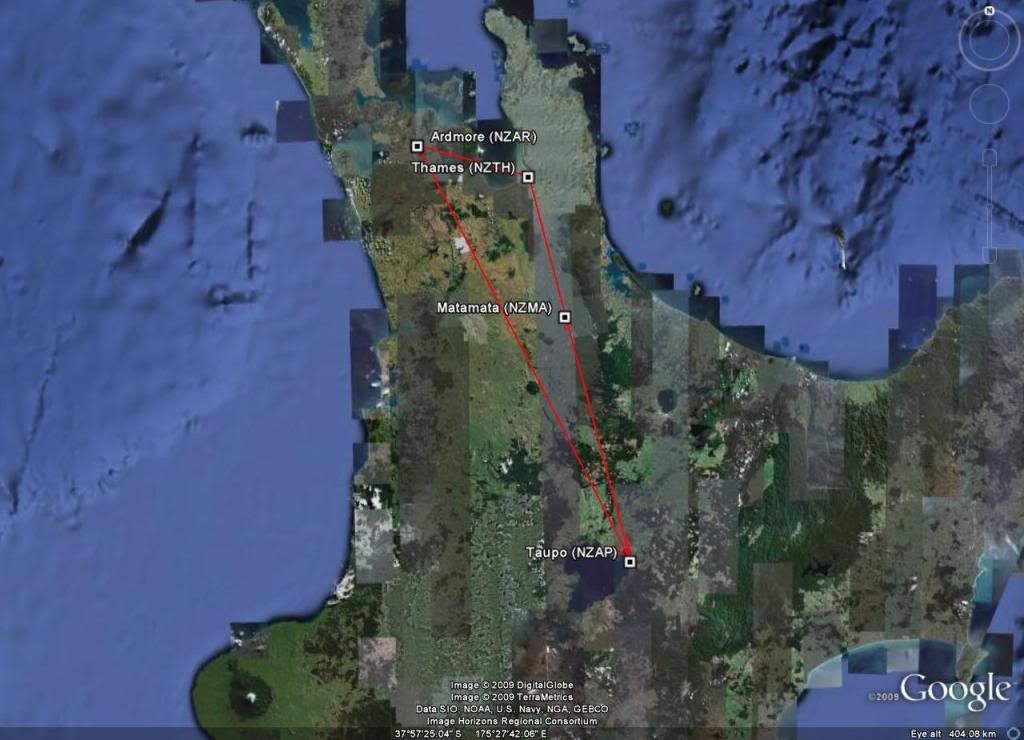
AR-(AP)-(MA)-TG, Divert (TH)-AR

The "plan" was to fly Ardmore (NZAR) - Taupo (NZAP) - Matamata (NZMA) - Tauranga (NZTG) - Ardmore (NZAR). But as I have discovered with dual CPL cross countries, what you plan and what you fly are two very different things :P

The trip to Taupo was pretty good. The winds were 'lightish' so the flying conditions were relatively smooth and the visibility was excellent. We could actually see Mt. Ruapehu while overhead Drury, which is a distance of about 250km!!!

I was really looking forward to getting some good photos of the mountains and Lake Taupo, until I handed my camera to Trevor and asked him to take some photos and he discovered that the batteries in the camera, which had been working perfectly in the morning, were now completely flat :( As I was too busy flying the aircraft and trying to do ground speed checks, plan my top of decent, look out for other aircraft and make radio calls, I couldn't be bothered trying to dig my cellphone out of my flight bag to try to get some pics on that...

I think I know what I want for my BDay/Christmas now... a nice little 'point and shoot' digital camera with a battery life longer than about 3 minutes :P

Anyway, we stopped in Taupo, gassed up, I had a bite to eat and visited the little boys room while Trevor checked out a car he is thinking of buying. Then we headed off into the clear blue skies and bade farewell to the snowy capped mountains and silky smooth lake and headed for Matamata.

After deciding I was a little bit off course, Trevor decided I should do a "1 in 60" to get to Matamata. Effectively you work out "Distance Off course divided by Distance Flown" and "Distance Off Course divided by Distance to Go". The first gives you the track error so far (usually a result of the wind not being what was forecast), and if you correct by that much you will end up paralleling your original track, but you will still be off course. In my case 2 nm miles off course after 25 miles flying or ~4 degrees. The 2nd calculation gives you the closing angle to arrive at your intended destination, so I needed to correct 2nm over the remaing 37 miles to Matamata (~3 degrees), resulting in a total correction of 4+3 or 7 degrees.

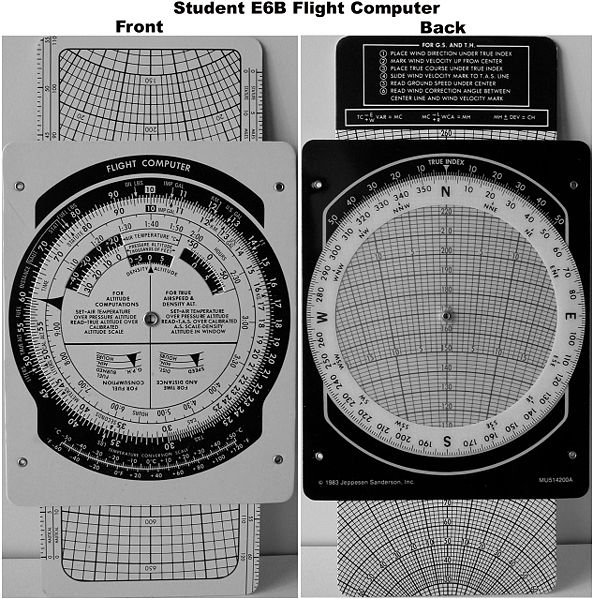
Now if it all sounds a bit like hard work trying to divide all sorts of random numbers in your head... you are right! That's why we use an "E-6B Flight Computer"... basically a fancy circular slide rule that makes a lot of aviation related calculations really easy ;)

The E-6B "Whizzwheel"

The "1 in 60" worked out pretty good, and I ended up pretty close (less than 1 mile) from Matamata. We dodged our way around the gliders, tanked up with gas and made ready to depart. At which point I learned that a 152, with 2 people on board and full tanks doesn't really depart that well from a runway consisting of relatively long grass! Even with shortfield technique we burned an awful lot of runway, but made it into the air eventually and with plenty of room to spare.

I was just commenting to Trevor that it was an awfully long take-off roll when he pulled the throttle 1/2 closed and called simulating. Lower the nose, Carb Heat On, Throttle Closed, Pick a paddock, Fuel/Mixture/Ignition Off. I hadn't seen the Engine Failure after take-off coming!!

He was satisified with my choice of paddock and we would have made it quite comfortably, so he called go-around and we climbed away on track to Tauranga. I had just got up to 2500' feet and managed to get Christchurch Info on the radio and pushed my SARTIME out when Trevor looked at me with a big grin and "Did I say Tauranga?? Oh, I meant Thames... oh and look at all that crappy weather (Clear Blue skies, visibility of around 60km :-/), ceiling is now 1500'"... So I started my diversion to Thames.

Due to the "crappy weather", I ended up with a ceiling of 800', so I was low (and slow) flying at 700' at 70knots. I called up CH Info and amended my flight plan and started heading for Thames. Eventually, "the weather" cleared and I was allowed to climb back up to 2500'. Just as I got there, and had everything sorted out and was planning my approach into Thames, Trevor pulled the throttle and said simulating.... AARRGGGHHH!!!

I was a bit rusty on the procedure for the forced landing, but I picked my paddock, planned an approach and would have put it in without too much trouble.

The nice long runway (14/32) at Thames is currently closed for maintenance, so I had the really short 500m runway (05/23) with a lovely approach for runway 23 that takes you quite close to some seriously high ground. I flew a really nice shortfield approach, touching down right on the threshold at minimal speed and blasted off again with plenty of room to spare. :D

I set heading for Ardmore and as usually seems to be the case, ended up arriving at the same time as everyone else :( I was just coming up to Hunua at 2000' and was about to report my position and intentions, when no less than 3 other aircraft all reported claiming to be exactly where I was! :-O I could only see one other aircraft and he was about 5 miles away!!!

I decided to stay out of the mix and gave everyone plenty of room and I slotted myself into a gap in the circuit traffic and landed without too much bother.

I was quite happy to be back on the ground after such an 'eventful' flight... and I definitely need to go and do some forced landing procedure revision before my cross-country flight test!


This Flight: 3.7 Dual (242 nm)
Total Hours: 209.0 (91.9/92.8 Day, 8.6/15.7 Night, 7.2 IFR)

Tuesday, 23 June 2009

Things that don't suck...


  1. Broken Vacuum Pumps

  2. Getting released from Jury Service on the first morning

  3. Large High Pressure weather systems covering the country in blue skies and sunshine

On Sunday, I had been planning a dual cross country with Trevor. Everything was looking good until about 1/2 an hour into the flight. We were overhead Lake Waikere, about 5 miles east of Huntly and noticed that the AH had fallen over. Thats when I noticed the Suction Gauge was reading right off the top end of the meter. Just as I said to Trevor "I wonder how long until the DI plays up?", The DI started doing it's best impression of a roulette wheel. Technically, an AH and a DI are not required for VFR flight, but seeing as we were so close to home, I decided to abort the flight and returned to Ardmore.

Monday, was the beginning of Jury Service... I was actually kind of keen (read as: curious) to go along and see what it was all about. So I headed down to the courthouse on Monday and sat in a room with about 100 or so others (most of whom were just interested in when they could go home).

After an hour or so, they did the 'lottery' and called up a whole bunch of people and sent them off to the various courtrooms... The rest of us sat around for another hour or so at which point they did another lottery for a trial that was due to start on Wednesday and then told everyone else they could go...

Seeing as how I had already arranged for most of the week off and the weather for the next couple of days was looking pretty good, I called my boss and asked if I could have Tuesday and Wednesday as annual leave.

So instead of debating guilt or innocence, I spent the week flying :)

Trevor was unable to get Tuesday off work, so I headed off for another Solo cross country. This time, I headed up North, hoping it might be a little warmer up there... I was wrong :(

Cold, frosty start

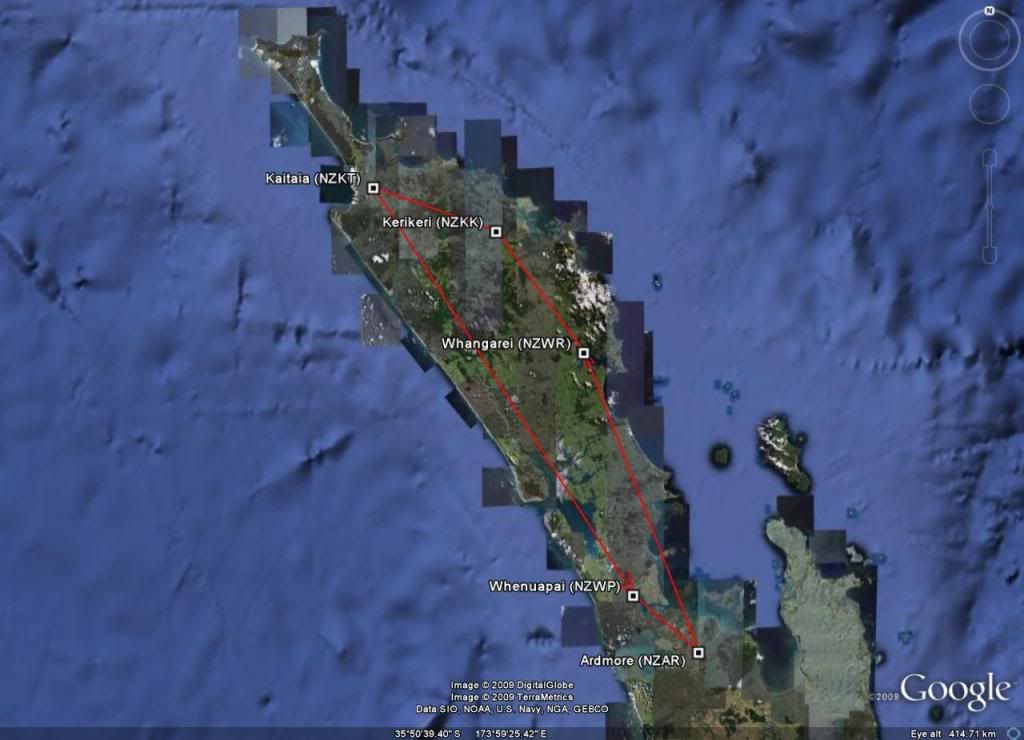
AR - WR - KK - KT - o/h WP - AR

I had planned for Ardmore (NZAR) - Whangarei (NZWR) - Kerikeri (NZKK) - Kaitaia (NZKT) - Ardmore (NZAR). The winds were a bit shifty at Whangarei, and even with full flap and power at idle, I was only descending at about 100' per minute! The end result was that I ended up high and executed a go-around. The next approach was much better and I got in with no trouble. I taxied back to the holding point and departed for Kerikeri. It was as quiet as always at Kerikeri, so I filled up with avgas, paid my landing fee in the Honesty Box and headed for Kaitaia.

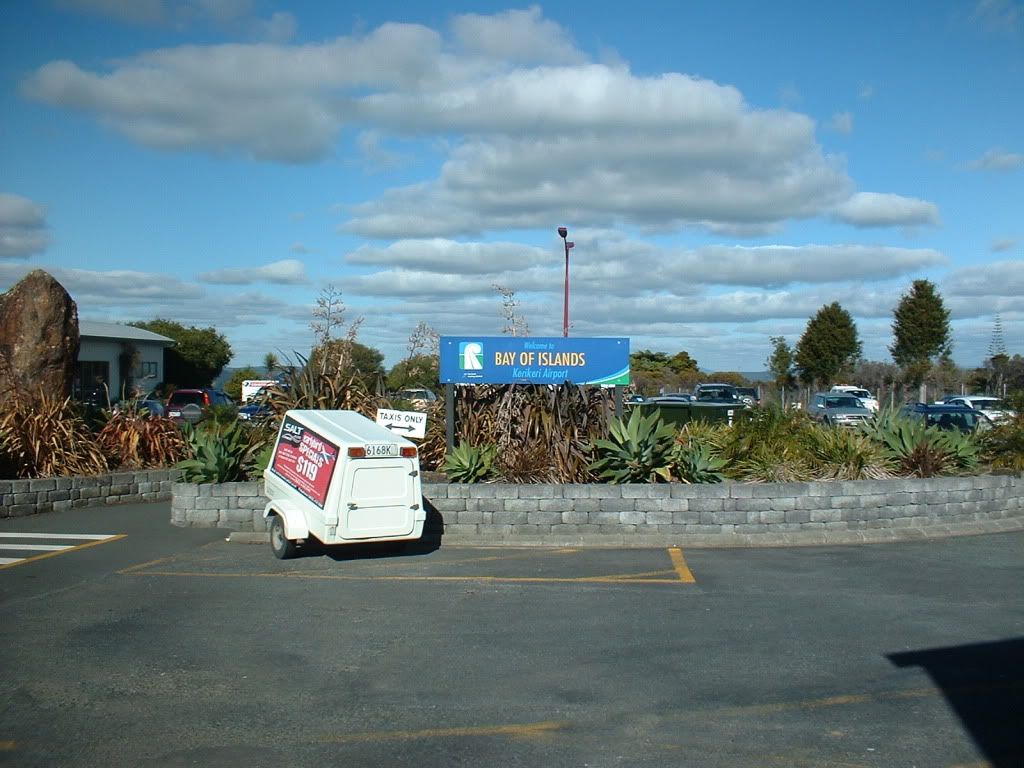
Welcome to the Bay of Islands!

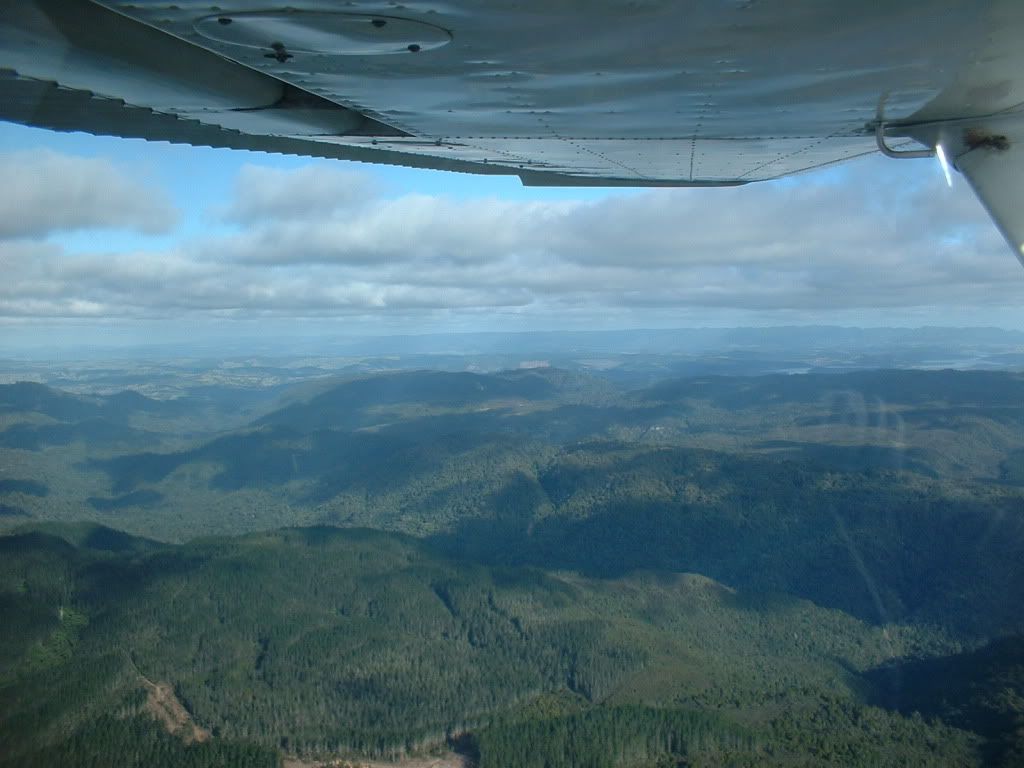
Tiger Country!

I noted on arrival in Kaitaia that the aircraft seemed to be burning a lot more fuel that it should be... I filled up again and made a mental note to check this with Chris when I got back to Ardmore. As it turns out, the dipstick was calibrated incorrectly (it was under-reading by about 5 litres), so I actually had more fuel than I thought.

Kaitaia Airport

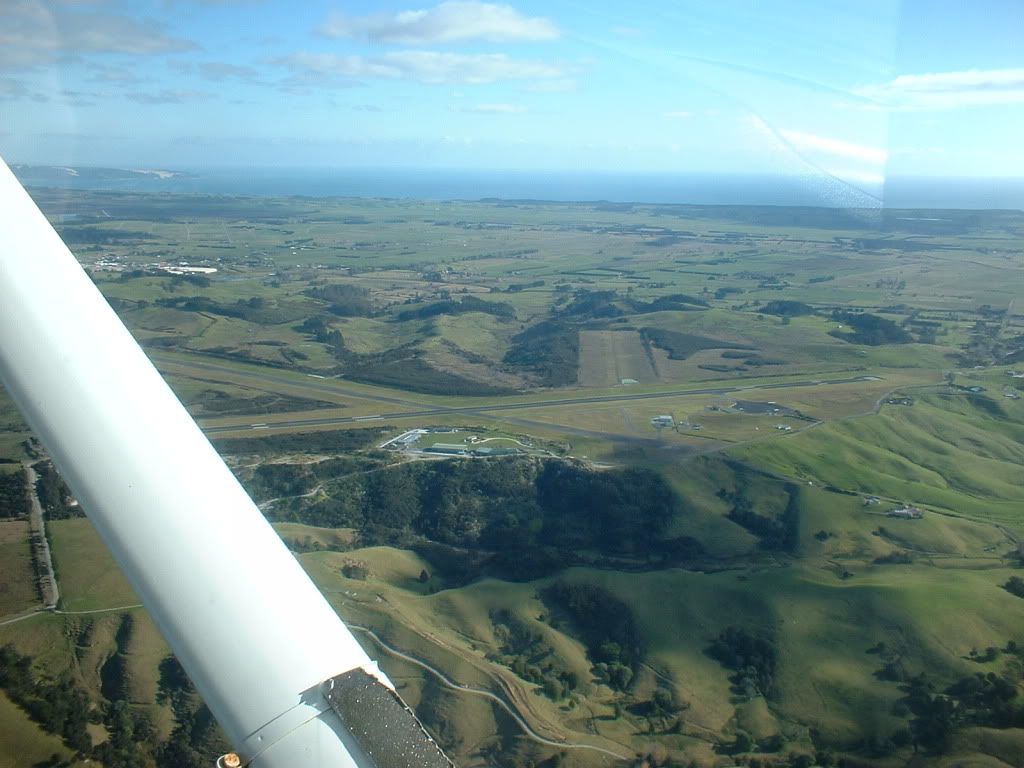
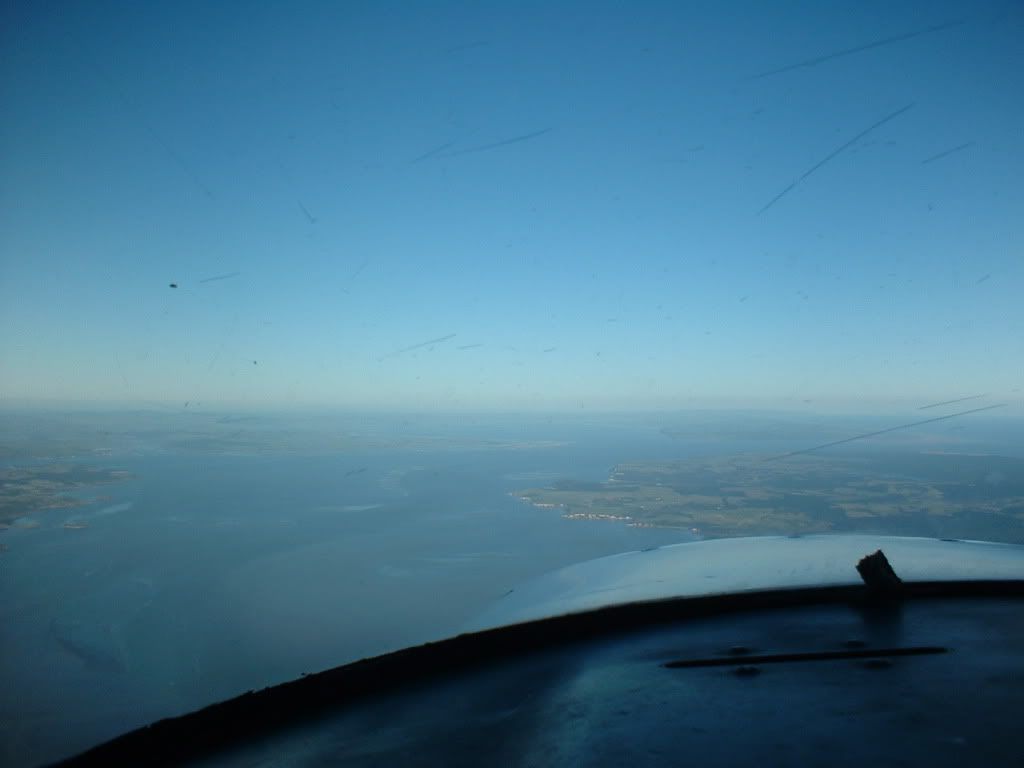
Kaipara Harbour at 4500', Nice and smooth but hazy

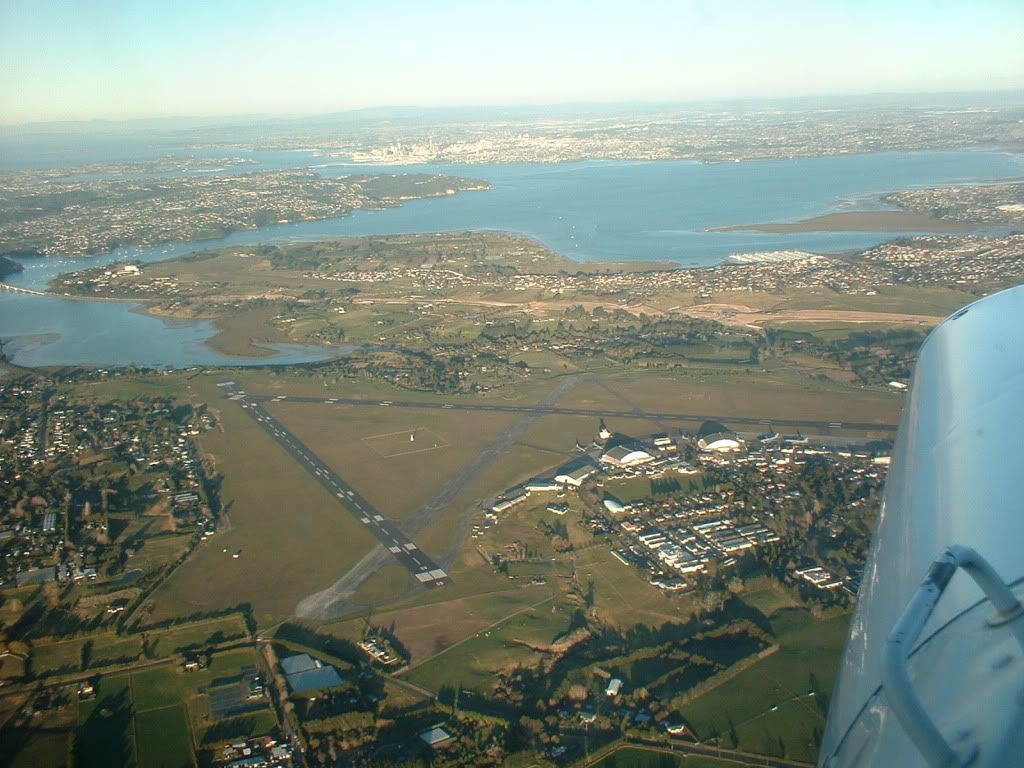
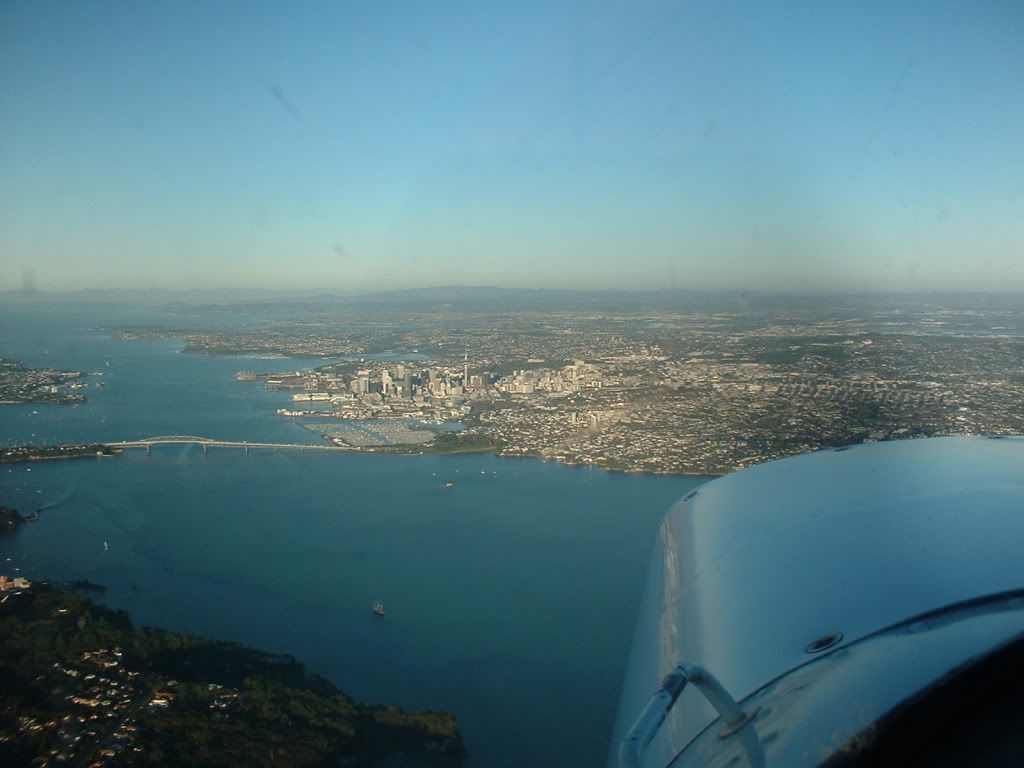
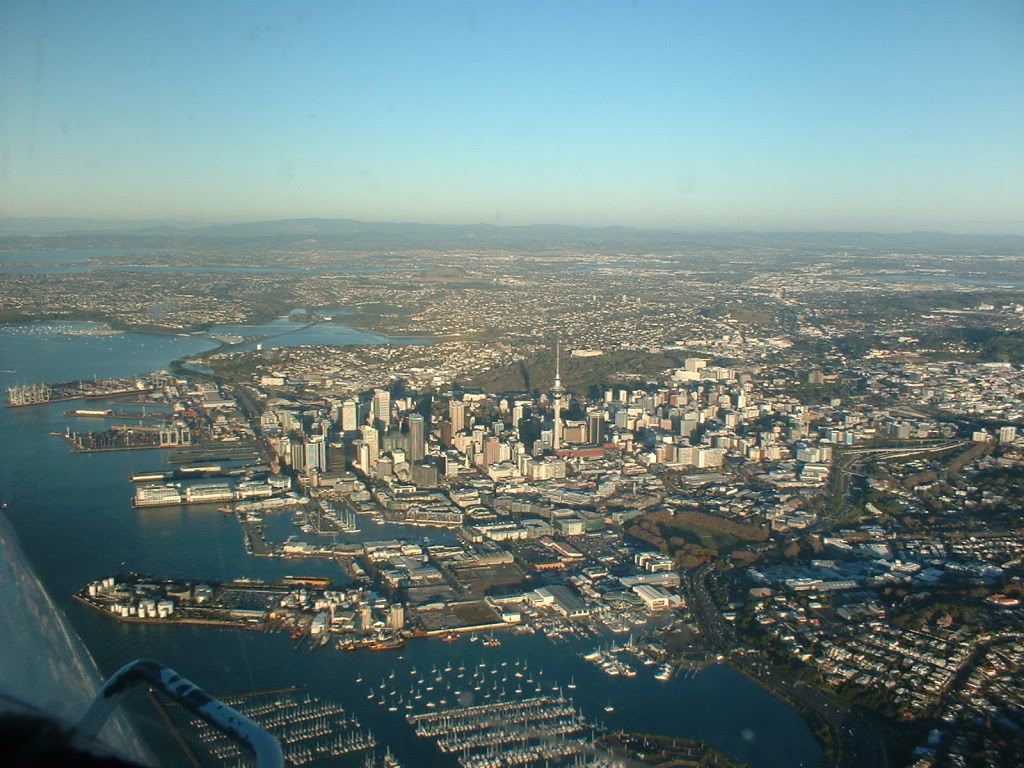
Following a suggestion that Chris had made before I left, after departing Kaitaia, I amended my flightplan to fly down the Kaipara Harbour and overhead the airforce base at Whenuapai (NZWP) and cut across their control zone back to the city. Some new airspace for me, and a slightly different perspective of the Harbour Bridge and CBD :)

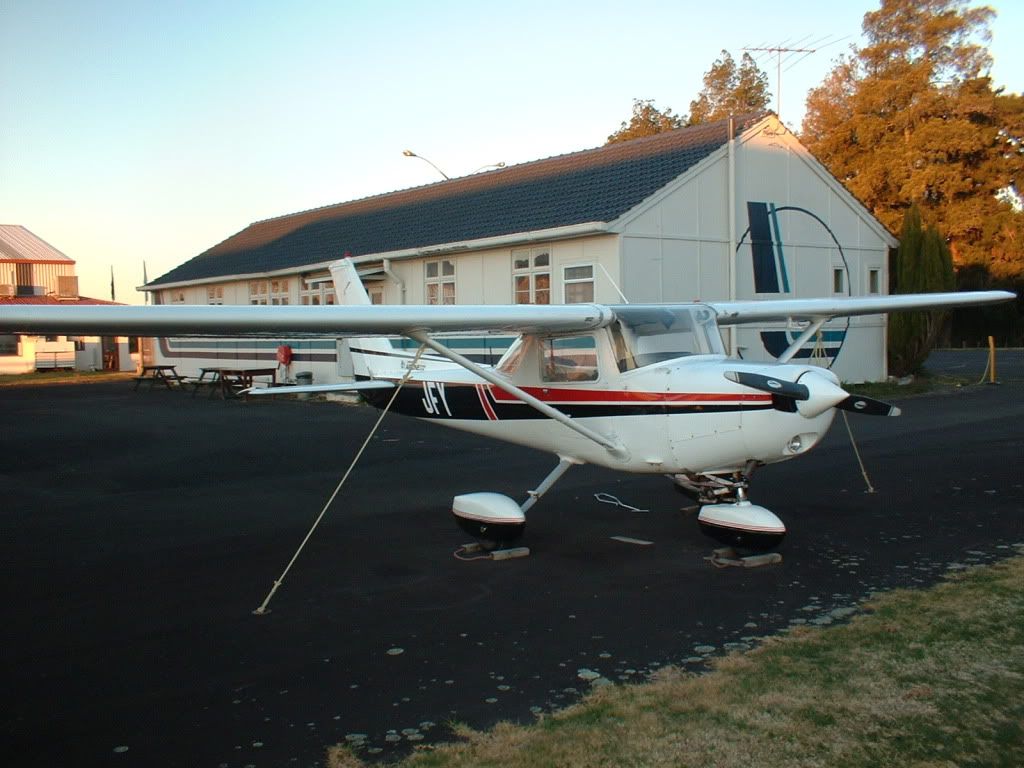
Cleared to overfly the tower, 2500' VFR, Juliet Foxtrot Yankee

Approaching the Harbour Bridge from the west

Overhead the Harbour Bridge - Awesome weather

The rest of the trip was fairly uneventful. Ardmore was actually pretty quiet for a change. Usually about 10 aircraft all arrive at the same time that I do! I secured the aircraft and went to have a well earned beer ;)

The trusty steed - JFY


Flights: 1.0 Dual + 4.3 Solo (295 nm)
Total Hours: 205.3 (88.2/92.8 Day, 8.6/15.7 Night, 7.2 IFR)