Showing posts with label NZAR. Show all posts

Friday, 15 November 2013

The best laid plans of mice and men...

Often go awry, as the quote goes...

I've been planning since June to get my Instrument Rating renewal completed with and ILS endorsement added. The yearly "competency" currency was due to expire on 12 July, so I started nice and early with some simulator and practice flights, hoping to book the Flight Examiner and get everything sorted in a timely manner.

However, the Flight Examiner was having his own currency issues... which caused a couple of weeks delay. Then the aircraft was out of action, then I was unavailable, then the weather was crap, then the instructor was unavailable, then I needed some recurrency training, then the weather was crap, then a new Flight Examiner was the choice, only he was waiting on various tests/paperwork etc, then the weather was crap... ad infinitum... *le sigh*... I had almost given up all hope of ever completing my renewal! :-/

Last week was looking good, I had a "practice run" on the Tuesday, that highlighted some points for improvement and was all set for the "test proper" on the Wednesday. I awoke to grey, dreary skies and rain on the roof... not necessarily a problem, that is what instrument flying is all about... so I checked the weather... The forecast was less than desirable, rain, strong winds and embedded "CB's" (Cumulonimbus... aka Thunderstorms) with accompanying turbulence and hail :-(

I made a nice early call to cancel and rebook for this week... and had it locked in for Wednesday. I then got a call on Tuesday from a 3rd party, who seemed to think that my renewal had been transferred to a "ferry flight" of a completely different aircraft type (Tecnam Twin instead of Partenavia), from a different airfield (Matamata instead of Ardmore) flying a different route (Matamata, Hamilton, Auckland, Ardmore) to the one expected and briefed (Ardmore, Whenuapai, Great Barrier, Ardmore)!!?! Several texts and phone calls later and it was all sorted. I'd still be in the Partenavia from Ardmore, just leaving later so the Flight Examiner could ferry the Tecnam up to Ardmore first.

No problems with a late departure, more time to prepare in the morning (perhaps even a bit of a sleep in! ;-) and less rushing about and less stress... or so I thought!

I woke up on Wednesday to blue skies and sunshine. Things were looking good. I headed out to Ardmore, preflighted and started flight planning based on my expected route. All I needed was the Flight Examiner to confirm a departure time so I could file flight plans with air traffic control and I was good to go.

And that is where it started to go a little pear shaped. I waited... I waited some more... I rechecked the weather... I rechecked the NOTAMs... I waited... I had lunch... I waited... Finally, I got the call.

The Examiner was delayed about 3 hours due to problems picking up the Tecnam... and I was struggling to get a training slot at Whenuapai, due to the military training being conducted in conjuction with the Australian airforce. I managed to get a tentative booking, but was going to be cutting it fine timewise. So much for a nice relaxed flight. The rush was on. I resisted the urge the rush though, fearing I might make mistakes if I didn't take my time and do all my checks thoroughly. A lesson learned from a previous flight. "More speed, less haste" etc...

It did mean that I was about 10 minutes late departing. Then due to traffic, was vectored around a bit and given a "non-standard" join onto the VOR arc at Whenuapai, where I intercepted it from a "random" course, rather than tracking via a radial. Thankfully, it was a scenario that I had already experienced once before (and gotten rather confused by, but had then had a subsequent session in the simulator to work it all out), so I nailed it! :-D

I was still concerned that we might run into trouble time wise, but as it turned out... even thought we arrived in Whenuapai's airspace about 20 minutes late, we were able to get our approaches and vacate before their exercises started. I guess we weren't the only ones running a little late!! :-P

I won't bore you with the details of the test, it was for the most part average at best... certainly not one of my better days at the controls and the phrase "skin of your teeth" was mentioned :-/ I was a bit disappointed with myself, as I know I can do much better and I pride myself on flying well, but I had passed and picked up my ILS endorsement (and some very useful reminders not to neglect the basics!!) along the way.

I now have the complete set of navigation aids (ILS, VOR, NDB, GPS) for my single pilot, multi-engine instrument rating... and a V. large hole in my bank account :-/

Hopefully, things will go a bit smoother next year. For now, the focus will be back into the books and studying for ATPL (Air Transport Pilot License) exams... and the never ending quest for a flying job ;-)

Saturday, 14 July 2012

More acronyms to add to the collection...


SP MEIR - ADF, VOR, GPS...

Or in "actual" words... A Single Pilot, Multi-engine Instrument Rating, endorsed for NDB[1], VOR and GPS approaches :-)

Another sticker for the log book
After a few false starts and delays (as covered in my previous post), and a flight test postponed due to the crap weather in the first week of July, the stars finally came into alignment and I ended up with flyable weather, a serviceable aircraft and a flight examiner... all in the same place at the same time.

So (very) early on Thursday morning, I headed out to the airfield, pre-flighted the Tecnam Twin (only thing of note were the muddy paw prints and cat fur located on the top of one of the engine cowls ;-) and extracted it from the hangar... thankfully, no "musical aeroplanes" required... and then taxied it around to the apron at the flying club.

I checked the weather and NOTAMs for my expected routes and noted that the freezing level was a little on the low side (5,000')... which was a bit of a concern, as the cloud base was forecast around 4000' and the aircraft doesn't have any anti or de-icing equipment :-/

The examiner showed up as scheduled at 0900 and we got down to business... working through the copious amounts of paperwork and red tape before commencing with the actual flying! :-P

So after confirming what I was testing for (Single Pilot, Multi-engine, with NDB, VOR and GPS) he checked that I had:
  • A valid licence and medical
  • A "Written Exam Credit" for the Instrument Rating Theory Syllabus
  • Completed the required remedial work as stated on the Knowledge Deficiency Reports (KDR's) from my exam results
  • A ground theory endorsement for the GPS equipment to be used in the test
  • Met the various minimum hour requirements necessary to hold an instrument rating
  • A type rating for the aircraft to be used in the test
  • A flight test acceptance slip
the examiner went over the format of the test and what was going to be required.  He outlined the basic structure of the flight which was:
  • Flight plan the route NZAR (Ardmore) - NZHN (Hamilton) - NZTG (Tauranga) - NZAR
  • We would depart NZAR via a published instrument departure
  • At NZHN, make the VOR/DME approach, via the DME Arc (demonstrating a hold before commencing the approach) for the duty runway, execute the standard missed approach and then head to NZTG
  • At NZTG, enter the NDB hold, then make the NDB/DME approach for the duty runway, execute the missed approach and then head to NZAR
  • At NZAR, make the RNAV (aka GPS) approach, demonstrating a GPS hold at the waypoint ORERE before commencing the approach, and then make a circling approach for the duty runway for a full stop landing.
I was then left to create a flight plan, fuel log, check weather/NOTAMs, check GPS RAIM predications and lodge my flight plans with ATC.

The only issue I had with this particular flight plan, was the fact that, despite planning on making some instrument approaches at Tauranga several times during my training, I had never made it due weather on the days we had planned to go.

I mentioned this quietly to my instructor while I was at the computer lodging my IFR flight plans, and he told me not to freak out... just remain calm and remember: "You don't fly at a particular place... you fly a 'plate'"

What he meant was that unlike visual flying, where you can use various physical references and landmarks to aid in making an approach so it helps to have been to a place before or at least received a briefing on what to expect... with instrument flying you just follow the instructions spelled out on the approach 'plate' aka chart and as instructed by ATC, as you may not necessarily be able to see out the window anyway!


Thinking back on it now... this was probably the best bit of advice I got before my test ;-)

By the time I had completed the flight planning, the examiner had come up with a list of around 10 questions designed to test my knowledge of Instrument Rating theory and law... covering things like:
  • The privileges & limitations of holding an instrument rating?
  • The currency requirements to fly IFR and make instrument approaches?
  • Various approach speed limitations for category of aircraft that we're using?
  • Can you make a visual departure at night?
  • What are the requirements for making a visual arrival during the day? at night?
  • Requirements for nominating an alternate aerodrome?
  • Non published alternate aerodrome minima for non-precision approaches?
  • What do we need to sight to continue below MDA?
  • Loss of comm procedures (In IMC on departure, on radar vectors)?
Thankfully, I had covered all of this material with my instructors so was able to answer all the questions (or at least reference the appropriate sections of the AIP to find the answers) without too much trouble.

We then went over my flight plan and the weather... noting the issues with the freezing level and what our options were.  He left the decision up to me, and I decided that given the cloud forecasts we should be OK and in the event that we did encounter icing, we had plenty of options to mitigate the issue, as we could descend to lower altitudes due to the Minimum Safe Altitudes (MSA's) being below our flight planned cruise altitudes and the predicted freezing levels... or climb out of the cloud as they were predicted to top out at 6000'.

We headed out to the aircraft, started up, set up the radio and navaid frequencies, requested and received our clearance instructions from Air Traffic Control, entered the initial flight plan in the onboard GPS and then I worked through the various pre-Take Off engine run-ups and equipment checks.  With everything in place, we lined up on 03 and I made my departure call.

We got airbourne, I was instructed to put on my "foggles" to simulate entering cloud once we had reached terrain clearance height on the instrument departure and away we went towards Hamilton.

The first leg was going well... I had remembered the "Twist, Turn, Time, Talk, Tune"... Twist my course selector to the required headings, Turn the aircraft and heading bug to the required heading, Time (not applicable to time anything), Talk to ATC as required, Tune radios and navaids to the new frequencies...  We were cruising in cloud, and the outside air temp was only 2 degrees, but I'd noted that while we had some visible moisture on the leading edge and engine intakes, there was no icing... I was feeling good.

Then 30 seconds later, the examiner says "What is MSA on this route?  We're going to need to descend, we're icing up, check the leading edge"... sure enough, and less than a minute since I had checked, ice was building up at an alarming rate.  We requested a descent to "non-standard 5000' due icing" and were immediately cleared as requested.  We dropped down from 6000' and popped out the bottom of the cloud and into slightly warmer air.  This was my first experience with icing whilst flying... and the sound the ice made as it started to crack and shed from the wings was a little disconcerting... the examiner commented that it was "some pretty impressive icing".

The rest of the leg to Hamilton was relatively uneventful... we were cleared as requested to join the DME arc and enter the TAYLA hold at 5000'.  That went without a hitch and we requested the approach.  They cleared us to descend to 3000' and to commence the approach for runway 18L.  We flew down to 'minimum descent altitude' (MDA) and tracked to the 'missed approach point' (MAP)... As I had no visual reference to the runway at this point (due to the simulated conditions wearing the foggles), I declared a missed approach, powered up and executed the missed approach procedure.

We received our onwards clearance and headed (for the unknown) towards Tauranga.  I started to feel a little nervous, having never done this before... but I just followed the procedures, and we arrived at Tauranga without a problem.  The first attempt at the NDB hold, which would have been almost perfect, was scuppered by the arrival of an Air New Zealand flight... which was given priority by ATC.  This meant that just as I was about to begin the inbound portion of the hold, they started radar vectoring me away from the aerodrome to create a safety zone for the other aircraft.  Unfortunately, I had to demonstrate a complete hold for the purposes of the test, so I had to do another entry and lap of the hold, from a more difficult position... not a huge issue, but it wasn't as tidy as the first attempt...

We then commenced the approach, I got a little high... this was due to my inexperience with the Tauranga approach and failure to recognise that I would require a slightly higher than normal descent rate to maintain the proper approach profile.  Still, I recognised the issue in time, verbalised my intentions and managed to regain the proper profile through some slightly aggressive descent manoeuvring ... not the best way to make an approach, but acceptable.

Again, we reached MDA and the MAP and again I was not "visual" so we executed the missed approach.  This time however, the examiner simulated an engine failure.  So while trying to fly the missed approach procedure and maintain the required rate of climb, I had to deal with an aircraft trying it's best to fly sideways on only one engine!!?!

I ran through the initial actions
  • Control Yaw with Rudder, Maintain Airspeed at "Blue Line" speed
  • Rich, Pitch Power! - Mixtures Rich, Prop Pitch full fine, Throttles full
  • Identify, Verify, Feather - Identify the "dead" engine by identifying my "dead" leg... When an engine fails on a twin, you end up with asymmetric thrust.  The result being that you need to put in a whole lot of rudder on one side to keep the aircraft flying straight.  So one leg is doing a whole lot of work.  The leg that isn't doing anything (ie. "dead") is the one on the side that has the failed engine.  We then verify that we have identified the "dead" engine correctly by closing the throttle on what we suspect the failed engine is... if it is indeed the failed engine, nothing should change, if we've chosen incorrectly, the aircraft will yaw wildly due to the rudder input no longer having to overcome any asymmetric thrust.  We then decide whether or not we're Terrain Critical (ie. Are we in danger of hitting something solid in the very near future?)  If we are, we just feather the failed engine to reduce drag and increase performance flying on one engine while we figure out what we're going to do to not die :-P.  If we aren't (ie. at a reasonable altitude) we can take our time, run some more thorough trouble checks and see if we can get the engine restarted.
At this point, the examiner asked "If this was real, and you were in IMC, what would you do right now?"  Noting that we were unable to maintain a climb rate necessary to ensure terrain clearance by following the missed approach procedure, I told him I'd turn back towards the navaid beacon at the aerodrome, and climb in the hold to the minimum safe altitude, advise ATC and then make an approach to land.

Happy with this plan, he gave me both engines back and we departed Tauranga for Ardmore.  Then something weird happened... I was tracking what I thought was pretty well, the ADF indicating that I was on the 278 course from Tauranga... the examiner says "check your tracking on the GPS"... turns out we were significantly left of track!!?!  Then ATC advised "MTW, confirm ops normal, you appear to be approximately 2 miles south of track".  I pointed out to the examiner that according to the ADF we were tracking correctly... he agreed, and we adjusted course to intercept the GPS track and the ADF still showed we were tracking correctly!!  ADF's are notoriously unreliable... so the examiner seemed willing to accept that I hadn't done anything wrong.

We continued towards Ardmore and, once again, we needed to request a lower than planned cruising level to prevent icing.  We were then cleared to track via the WAIKA and ORERE waypoints to make the RNAV (GPS) approach for Runway 21 at Ardmore.  They were actually using Runway 03, but that was OK, as it gave us an excuse to do the circling approach, where you fly the approach to one runway, achieve visual reference and then circle around to land on another runway.

Up to now, everything had more or less gone OK (aside from the ADF issue), I hadn't been advised that I had failed (which the examiners are required to do so you can cut the flight short to prevent wasting money flying approaches that are unnecessary) and I had always found the GPS approaches to be relatively easy.

So, naturally, I did my best to screw everything up on the GPS approach. :-/

It went wrong near the end of the holding procedure... for some reason, and I'm still not sure why (possibly just fatigue towards the end of a stressful 3 hour flight??) I got a bad case of "fiddle with the GPS"-itis... I naturally, pushed the wrong button, and ended up making a messy approach back to the ORERE waypoint to commence the final approach.

The whole way down the final approach I was cursing my stupidity under my breath, thinking that I had just blown the whole test.  On the final approach, I got another simulated engine failure, which helped me forget about the mistake and focus on flying... I then flew the circling approach and made a full stop landing on only the one engine.  Ironically enough... one of my better landings! :-P

We taxied back to the club, shutdown and as I started to note down flight times for the aircraft flight logs, the examiner said "I'll see you in the briefing room", he collected his stuff and headed into the clubrooms.  My instructor and a couple of others came to help secure the aircraft and refuel asking the usual "How did it go?" type questions... fearing the worst I replied dejectedly "I think I just blew it on the GPS approach".

I headed into the briefing room to receive the "bad news"... I could hear the examiner and my instructor talking outside, and then the examiner went to make a quick phone call to advise his next test candidate that he was running late.  My instructor came in and said "don't panic, I think you're OK"...

The examiner came in and asked me to debrief the flight to my instructor... basically walk him through the flight, saying what went well, what didn't etc...

I was, in my opinion, brutally honest... I started by saying it was far from the perfect flight.  The initial departure was good, the VOR/DME at Hamilton was OK, the initial NDB tracking and hold at Tauranga was OK, I got high on the approach, but recovered OK, tracking out of Tauranga we had the issue with the ADF tracking, the initial GPS tracking and hold entry were OK, then I got trigger happy and screwed up the end of the hold, the final approach was OK, the circling approach and a fairly decent asymmetric landing.  I commented that some of my height holding was a little poor... and while the conditions were fair from perfect (a bit lumpy and bumpy in the clouds), it was not completely to blame.

At this point, (and to my HUGE relief) the examiner commented "Well, it's a pass, a little marginal, but a pass... based on your self-assessment, you obviously have high standards, don't lose them... I'm giving you a licence to learn, so don't rush off and fly to MDA in hard IMC your first time out OK?" and gave me the customary handshake.

3.1 hours... a long flight test

We finished up the paperwork, I thanked him profusely and he headed off to torture his next victim[2] his next flight test appointment.  I think it only really sank in about 5 or 6 hours later, after the obligatory bar shout, that I had actually passed...

Not all 4 letter words are bad!

I'd like to thank my instrument instructors, Phil Welcome and John Ashman for helping me achieve this rating... MTW for being a sweet little aircraft that flies right and (mostly) works OK... various pilot/instructor friends for various tips and tricks with regards to instrument flying...

and last, but by no means least, my awesome GF... for putting up with a very busy (and stressed!) BF and providing lots of support and being very understanding these last few weeks (and months) as I tried to get this damned rating finished!!  Thanks babe... ;-)


[1] No... I don't know why they use the acronym for the cockpit instrument as opposed to the navigational aid??!?
[2] I think it only fair to point out that the examiner was actually very nice and made the whole thing a lot less stressful than I had anticipated ;)

Sunday, 27 February 2011

Success, Postponement & Commercial Reality

So I successfully completed my Multi-Rating... spending a small fortune along the way, desperately trying to maintain control of a twin with the benefit of only one engine in all sorts of situations (during take-off roll, after take-off, in the cruise, in the circuit, on approach, on short final below DA (Decision Altitude) but having some of the most fun I've ever had whilst flying!

The emergency gear extension was interesting... opening a little hatch in the floor and using a little metal bar to turn a small value that just drops the gear down using gravity. Was somewhat re-assuring to know that in the event of the electric hydraulic pump failing, it might still be possible to get the wheels down...

An engine shutdown... and a (thankfully successful) mid-air restart... I have to say, despite the smile on my face (see below), flying around with the prop completely stopped was a little unnerving... especially after having spent 300+ hours in single engine aircraft where a stopped prop = BAD! :P

Look Ma, No Engine!


Then came the realisation that I was not going to be able to continue with my Instrument Rating... I had hoped to do it in the Duchess, but unfortunately, several critical pieces of avionics decided to release "The Magic Smoke™" rendering it unuseable for IFR flight :(

So I decided that I could just switch to the Partenavia P68 and do my Multi Instrument rating in that... but was unable to secure a test date at a suitable time that would leave me enough time to train, complete the test and make it to the UK in a timely manner (more on this later)...

So the decision was made, very reluctantly, to shelve the Instrument Rating until I return from my Northern Hemisphere adventure... As it turns out, due to several other factors, such as the Christchurch Earthquake and navigation equipment maintenance, there is pretty much no instrument training occurring at present so the decision was most definitely the right one.

So I was wondering what I was going to do to keep busy... at which point I was then asked to go and do some more aerial photography, only this time, away from "Home"... So I packed some clothes in a bag, put some spare oil in the back of DJU, made sure I had the fuel cards onboard and headed south.

"Jules" looking awesome in front of Mt Egmont (NZSD)


12 days & 41.3 hours "down country" later... I've seen a fair bit of the Taranaki & Manawatu... Managed to operate in and around the airforce base at Ohakea without annoying anyone, chatted with Police and Airforce crew at Foxpine (NZFP) who were out "doing some gardening" in an Airforce Iroquois helicopter ;), met some real characters like John the Pom, all the while "enjoying" some of the realities of commercial flying, and having a total blast...

"Jules" tucked up ready for bed at Foxpine (NZFP)


Now I mentioned the UK earlier... well this is one of the reasons I'm delaying the Instrument Flying... I've been offered the opportunity to head to the UK to do some flying up there for 6 months over the northern summer (yay! 4 summers in a row!!) So, as soon as I get back from the current round of flying about the countryside (currently in a Motel room in Masterton!?!?) I'll be packing up my life and heading to Ol' Blighty...

Fun times...

Monday, 24 January 2011

New Year, New Aircraft

Ok... so I kinda got caught up in the hustle and bustle of Christmas (read as: more partying and alcohol than my aviation doctor needs to know about! ;) and didn't fly for the rest of December :(

But I made up for it by taking my Sister, her husband and 2 of their friends from Ireland who are semi-backpacking around the world for some scenic flights around Auckland in LMA on January 2nd...

The weather was awesome and the it was a great way to start the New Year ;)

Following that I skipped over to Australia to catch up with my Neice and Nephews in Melbourne as my Brother and Sister-in-Law had been unable to make it over to for Christmas with the rest of the family :(

I then foolishly made the mistake of flying up to Brisbane to catch up with an old friend... during the worst flooding since 1974!! Thankfully the airport was still open the day I left, despite the buses and eventually the trains being shutdown!

Once back, I decided it was time to finally get back into the flying stuff, the primary focus being getting my Multi-Engine Instrument rating.

However, the club recently negotiated the use of a Piper PA-38 Tomahawk, ZK-EVL. So I figured I'd add another type rating to my growing list ;)

Now the Tomahawk has a reputation in the aviation community and some would have you believe the "Trauma-hawk" is a death machine, but having never flown one I was trying to keep an open mind.

My type rating was duly completed, included watching it "waggle it's tail" during stalling, but to be honest, it was fairly benign... sure it drops a wing pretty much every time you stall it, but that isn't particularly difficult to deal with, and I actually found it to be a very nice little aircraft, and EVL is a really tidy specimen. The cabin is nice and roomy, a lot bigger than a 152. It has awesome visibility and, was generally, just a real pleasure to fly.

Next up... the multi-engine rating... my first lesson is booked for Thursday! :)


These Flights: 2.3 PinC + 1.4 Dual
Total Hours: 316.7 (150.4/140.3 Day, 8.6/17.4 Night, 18.6 IFR)

Wednesday, 8 December 2010

Cloud punching

Instrument Time - Actual: 1.5

Hah! take that clouds... I laugh at your inability to stop me flying where I want :p

My first IFR cross-country... What a ride... AR-HN-AA-AR or Ardmore to Hamilton via the Waiuku NDB, a couple of approaches and holds at Hamilton, then back to Auckland International to make an ILS approach via the Surrey NDB, then home to Ardmore...

Well, that was "The Plan"™... only those tricky controllers are far to wise to make things that easy!

Somewhere between flight planning and getting overhead the Waiuku beacon, the wind at Hamilton changed, so my plan for a "VOR/DME RWY 18L" approach quickly turned into a "VOR/DME RWY 36R" approach...

Not a big deal... join the arc, make the approach, missed approach into the hold... transition to the NDB hold, make the NDB approach, missed approach and onwards to Auckland (via Surrey)...

"Delta Juliet November, be advised, a 15 minute hold for the ILS"... yeah no worries, it's only money :P

At which point Auckland Control had a minor comms failure... eventually they sorted themselves out, turned me back towards the hold at Miranda... I Split the ADF needles on the entry to the hold... (yeah baby!) and was looking at making a perfect parallel entry "Delta Juliet November, Cancel Hold turn left, heading 280" grrrr...

Then vectored into the hold at EMRAG... "Delta Juliet November is entering the hold at EMRAG", "Roger, cancel hold turn right heading 210"... GAAAH!!!!!

Intercepted the ILS for the approach into Auckland International with World+Dog (3 aircraft in front, 2 behind)... was eventually told to slow from 140kts to 120 as we were catching the jet in front :P

Made possibly the worst ILS approach in history (despite Instructor Phil saying that wasn't too bad)... damn that needle is sensitive! and then executed the missed approach, heading back to Ardmore under Visual Flight Rules...

Time for a cup of tea... and just to make my day even better, the nice Cookie Time Girl arrived with my bucket of Christmas Cookies... OM NOM NOM!


This Flight: 3.0 Dual (1.5 Actual IFR, 1.0 Sim IFR)
Total Hours: 313.0 (149.0/138.0 Day, 8.6/17.4 Night, 18.6 IFR)

Tuesday, 7 December 2010

Prior Experience

So having been checked out to Waiheke the day earlier, I got to put the lessons I had learned with Chris to good use on Saturday, flying some friends for a scenic and then dropping them at Waiheke for an afternoon of cafe's and vineyards before I picked them up and dropped them back at Ardmore.

The weather in the morning was a little marginal, which some low "scungy" cloud hanging around, making it hard to do any real scenic flying, but thankfully it was high enough that we could get into and out of Waiheke without too many issues. The weather had vastly improved in the afternoon, so we able to do some decent scenic flying around the gulf and the Hunua Ranges on the way home.

The wind had picked up in the afternoon, and while the Waiheke procedures state they prefer take-off's and landings to and from the south for noise abatement (ie. we don't want to annoy the neighbours by flying over their homes), I was not comfortable with taking off downhill with a 10 to 12 knot tail wind just to keep the noise down! I know that the 182 is capable of it (having had it demonstrated on another student's check flight to Waiheke a year or so ago), but the safety of the aircraft and those on board come first as far as I'm concerned. As it turned out, with a max performance take-off and the headwind, we were airbourne about halfway up the strip and we were able to easily make a right hand turn once airbourne to pass well clear of any homes to the north of the strip.

A satisfactory outcome for all concerned :)


This Flight: 1.8 PinC
Total Hours: 310.0 (146.0/138.0 Day, 8.6/17.4 Night, 16.1 IFR)

Friday, 3 December 2010

Flying on faith

So I now know what faith is... it's the belief that the little needles on the little dials on the little instrument panel of a little aeroplane is indeed telling the truth.

1.8 hours of "faith" later, and I had literally worked up a sweat... the inside of the instrument hood was dripping :P

Today was ADF approaches. So instead of "comfortably" flying around at 2500' feet flying holds and tracking to and from NDB's, we left the safety of altitude and practised flying approaches to "minimums".

"Non-precision" Instrument Approaches (like NDB approaches) are designed to allow you to fly safely down to fairly low altitudes, as long as you are where you think you are (faith in the instruments)... the idea being that you drop below the cloud base, spot the runway and commence the actual landing part visually.

Flying to minimums basically means that you fly to the lowest altitude allowed and hope you spot the runway before you reached the "missed approach point", at which point if you haven't spotted the runway, you get the hell out of dodge and climb back up to a safe altitude.

As I was simulating instrument flying conditions with the hood on, I never got to see the runway... so every approach resulted in a missed approach, back into the hold and then time to setup for another approach.


And just because I hadn't had enough "fun" for one day, I went for a quick afternoon jolly with Chris over to Waiheke, to get checked out for landing there... the club have a policy whereby members must first fly a dual check flight here due to some interesting quirks that Waiheke has... like the 45 degree offset approach for runway 17 due to noise abatement procedures, this is also complicated by the the fact that the runway has a pretty pronounced downhill slope in this direction, so if the wind is a moderate southerly you are in for a fun ride ;)

Taking off uphill can also be a challenge as it's harder for the aircraft to the necessary airspeed while it's rolling uphill and then you need to outclimb the slope once airbourne...

Thankfully, the 182 has bucketloads of power and eats the strip alive... even with a moderate tailwind landing downhill! ;)

So after doing some p-charts to confirm that we could safely get in and, arguably more importantly, out again... we headed off to Waiheke, completed take-off's and landings in all directions to get a feel for all the approaches and to see that it actually makes more sense sometimes to land with a small tailwind because it's up the hill than to land down the hill with a small headwind!


These Flights: 1.8 Dual (1.4 IFR) + 0.8 Dual
Total Hours: 308.2 (146.0/136.2 Day, 8.6/17.4 Night, 16.1 IFR)

Friday, 26 November 2010

Needles and Racetracks...

This week has been an interesting aviation week... I was "Re-educated" in the use of an E6B by a very knowledgeable instructor... I also learned more about Automatic Direction Finders (ADF's) in 20 minutes in a briefing room with this instructor than from all of the reading I have been doing of instrument rating study guides.

I then proceeded to spend over $1000 flying around in circles... and I didn't even get to enjoy the view!! :P

Yesterday was basic ADF tracking... or "How to make a needle point where it should" ;)

This involved taking off from Ardmore and flying out towards the Surrey and Miranda NDB's (Non-Directional Beacon's) and flying to and from the beacons on various headings as instructed by Instructor Phil... By learning a couple of basic principles, the "smoke and mirrors" of ADF tracking suddenly became a reality...


  1. You're not on track if the needle is pointing at the wrong heading

  2. The head of the needle "falls" to the tail of the aircraft

  3. When tracking "TO" an NDB, to make the needle rotate right, you rotate the aircraft left (and vice versa)

  4. When tracking "FROM" an NDB, to make the tail of the needle rotate right, you rotate the aircraft right (and vice versa)

  5. If the head of the needle rises, you haven't made enough allowance for wind


Today was ADF holds... or "How to fly nice racetrack patterns in the sky". This lesson built on the basics from yesterday, but threw in some added fun bits, like holding pattern entry procedures (Parallel, Offset and Direct entries)...

I had another student tagging along, who brought along his Garmin 296 GPS, so when we got back I could have a look at my flight path, and while the first couple of holds were a little "wobbly", the steadily got better and better, until I was flying very nice racetracks indeed :)

A very solid 2 hour workout!

Then in prep for our club trip to Taumarunui on Sunday, I went and go current in the 152 this afternoon... with 3 quick circuits in JFY in an almost empty circuit... BLISS!


These Flights: 1.5 Dual (1.2 IFR) + 2.0 Dual (1.6 IFR) + 0.4 PinC
Total Hours: 305.6 (143.4/136.2 Day, 8.6/17.4 Night, 14.7 IFR)

Monday, 8 November 2010

300

No, not a post about Sparta...

I have managed another mini-milestone... 300 Hours Total Time :)

After another weekend of pretty awesome weather, I racked up another 8.1 hours while flying about the countryside which has pushed me to 301.7 Hours...

Saturday was a nice early start and a short hop across the city, over to "Vanilla Pie" (aka Whenuapai) before their airspace got too busy with gliders... at which point we headed for Swanson/Henderson and Waitakere, getting a little too close to the Auckland Control Zone/Area for my liking... I really need to invest in a Garmin 296 so I don't have to rely on guesstimating where the airspace really starts ;)

Sunday was a little less stressful... a nice cruise up north for a looksee around Mangawhai Heads and then onto Whangarei. A quick "recce" around the area before stopping to refuel both aircraft and occupants. As always, the little cafe in the Whangarei Airport Terminal provided some really good food... Choc Fudge Brownies FTW!! ;)

Then it was back into it, covering the area north of the city, around the airfield and along the coast east of the airport.

I would also like to give a big shout out to the Eagle Air pilot's who flew into NZWR on Sunday afternoon, they're very accomodating to us folk in the lighties... despite me offering to hold early downwind so as not to get in her way, the pleasant voice on the radio told me to go ahead and she'd slow down her approach :) And later, when we were flying around north of the city, I heard another approaching Eagle Air Beech 1900D pilot let a 172 from Ardmore Flying School in ahead of him...

Then it was home for "Tea, Buns and Medals" as Mel says... personally, I had a beer ;)

In other news, I finally got around to rewarding myself for getting the CPL. I purchased a Lightspeed Zulu headset... OMG, this thing is simply the best headset I have ever worn.

It wasn't exactly cheap, but after my 4 hour flight on Saturday, I barely even knew I had a headset on it was so comfortable... Lightweight, ANR (Active Noise Reduction) and with an auxiliary input jack for piping music from my phone (which automatically cuts out when getting radio/intercom transmissions)...

There is nothing quite like cruising around in the sunny blue skies listening to some nice chillaxing sounds ;)

My only regret is not buying one sooner!!


These Flights: 3.9 + 4.2 PinC
Total Hours: 301.7 (139.9/135.8 Day, 8.6/17.4 Night, 11.9 IFR)

Thursday, 4 November 2010

Crap... I'm dead?!!!

So, I received a phone call approaching Huntly... a somewhat difficult task given the excessive noise of the rather modest powerplant of the Cessna 152... I shouted "We're still flying" into the microphone of my mobile, pressed the "End Call" button and then sent a text to the caller saying "What's up?"... the reply?

"You're dead, according to SpiderTracks"

Rewind 1hr and 39mins... and Irene and I are taxiing out to runway 03 after ECT (Evening Civil Twilight aka. night time) preparing for a night cross-country down to Hamilton for some circuits.

Unfortunately, my "point and click" digital camera is less than useless at night photography, so I have no pics to show, but it was one of those nights that reminds you why you wait patiently for the sun to descend below the horizon to go flying... we could see the lights of Hamilton as we departed via the downwind from Ardmore... the long yellowish snake of State Highway 1 stretching out into the darkness before us. I was there as pax, with Irene wanting to rack up some PinC/Night flying time...

Following a relatively uneventful flight down, we arrived overhead Hamilton to join a (surprisingly) busy circuit... with 3 or 4 CTC aircraft doing the rounds. 5 or 6 (rather large!!) circuits later and Irene decided it was time to head home, so she called departing and we headed back north...

Despite SpiderTracks indicating that our flight had ended somewhat abruptly somewhere between Ngaruawahia and Huntly, we made it back to Ardmore safe and sound... at which point several phone calls were made to allay the concerns of the parties receiving emergency alerts.

No (real) harm done, but a story about a young man and his fascination with "canis lupus" comes to mind :-/

Thursday, 28 October 2010

$200 $10 Fish 'n Chips...

And an Ice-cream! :P

So I found a way to fly about the countryside, sampling the wares of the various Fish 'n Chip vendors without busting my piggybank...

Find a CPL stupid who is "PinC" hour building and wants some company! :)

So I bundled myself (along with sunscreen) into the right hand seat of one of the clubs 152's, and enjoyed the view out the window as we headed for Raglan.

Climbing out of Ardmore


Thankfully, the weather today was a lot nicer than our previous effort (hence the sunscreen) and we arrived into Raglan without incident.

A short walk from the airfield (after paying the "outrageous" landing fees at the camp office) over to the Camp Store and then we were sitting in the sun enjoying some very nice fresh gurnard and chips... OM NOM NOM!! ;)

$5??!? Simply Outrageous! :P


Pilot in Command


Lunch... YUM!


This was, of course, followed by the compulsory Ice-Cream... (I went for the Magnum Gold today) which was duly consumed before arriving back at the airfield!

Irene chose a max performance take-off (probably a good idea with both of us full of fish 'n chips! ;) and we tracked along the coast heading north... Saw some interesting rock formations, I have no idea if it's due to the type of rock or the eroding action of the sea or a combination of both... but they look cool :)

Interesting rock formations on the coast


As usual, we managed to time it "right" so we arrived back at Ardmore just as World+Dog was also arriving, so the circuit was all sorts of chaos :-/

Irene opted for the grass and asked if I'd mind if she did a couple of practise circuits before full stopping.

I gave her my 'Standard Pilot as Passenger Response™'.... "You're PinC, I'm just along for the ride" ;)

Thursday, 14 October 2010

View from the Right Hand Seat...

So I tagged along today with one of our CPL students who was doing some "Pilot in Command" hour building...

The plan was Ardmore - Hamilton (some circuits) - Raglan - Ardmore... The weather at Ardmore was blue skies and sunshine and we were both hoping for some fish 'n chips at Raglan ;)

Unfortunately, Mother Nature decided to interfere... Upon arriving in the Hamilton CTR, things got very grey and very wet... and the PinC decided a full stop landing would be a good idea after the 2nd circuit.

So we taxied over to the Waikato Aero Club... checked the weather, let "mother" know what we were up too and waited for the band of showers to pass...

20mins later and we were back into it, going round in circles dodging CTC Twinstar's doing asymmetric circuits and airline traffic, before being cleared to the west at 2500' or below...

So, off to Raglan we headed... the PinC taking the opportunity to get some Simulated IF time while I played "Safety Pilot"... weeeeeeee!

Unfortunately, we (and by we, I mean me, as PinC was busy flying ;) noticed on the first circuit at Raglan that the fish 'n chip shop near the camp ground appeared to be closed, so we decided to cut our losses and head back to Ardmore... :(

Still... a fun day with low stress for me... I just got to sit there and work radio's and organise charts and aerodrome plates and let the PinC deal with all the really fun stuff like dodging clouds, other aircraft, dealing with controllers etc :P

Wednesday, 6 October 2010

$200 Fish 'n Chips...

Ingredients:

1x PA28-180 (ZK-LMA)
1x CPL
1x Freshly minted C-Cat
Plenty of AvGas 100
1x Fish 'n Chip shop
1x Seat by the beach
Some decent weather

Directions:

- Take decent weather, put CPL and C-Cat in PA28, add AvGas.
- Point PA28 in the general direction of Pauanui.
- Let PA28 cruise for about 40mins.
- Upon arrival in Pauanui, remove CPL and C-Cat from PA28.
- Combine Fish 'n Chips and a seat by the beach with CPL and C-Cat.

(Optional)
- Garnish CPL with Gooey Raspberry Memphis Meltdown and Watermelon Chupa-chup before sending back to Ardmore.

C-Cat getting current on PA28


OM NOM NOM!


NZUN


I'm living the dream ;)


This Flight: 0.8 PinC
Total Hours: 279.4 (139.9/114.8 Day, 8.6/16.1 Night, 11.9 IFR)

Saturday, 2 October 2010

What goes up... hopefully comes down!

Full throttle, airspeed increasing, lift-off... climb established... flaps up, climb power set, climb RPM set... nil runway remaining, tap the brakes, gear up... bzzzzzzzzzzz *THUD*... orange light...

And so began my foray into "suck-up wheels"... aka. retractable landing gear

The club recently got a Cessna 172 RG "Cutlass" ZK-EWP on the flightline, and I had been dying to try it out. I was supposed to start my type rating last weekend, but had to defect the aircraft during the pre-flight due to some misbehaving cowl flaps.

The defect was fixed earlier this week, so then it was a matter of waiting for the instructor... Today was not a bad day for aviating... a little bumpy, but nothing like the 30knot+ winds we've had recently! And besides... I needed an excuse for not studying for my Instrument Exams :P

So I duely pre-flighted EWP, strapped in the CFI and headed for the training area for the usual runthrough of maneuvers required for a type-rating... turns, stalls etc... only this time we also played with the gear, getting used to the pitch changes as it went up and down... what the "gear horn" sounds like etc.

After that we headed back to the airfield for an overhead join and some circuits which I thought were barely passable... the circuit gets very busy when instead of throttle, mixture and flaps, you now have throttle, mixture, flaps, pitch, cowl flaps and undercarriage to worry about... and an aircraft that will easily do 120+knots downwind if you let it!

As Rob had said during the briefing, if you get setup early, and slow down before you enter the circuit, you'll be fine... Apparently these old, gray-haired instructors know a thing or two about this flying malarky :P

A couple of circuits later and we taxiied back in as Rob had another booking... and I needed a cup of tea and a lie down!

1.0 hours of pure busyness :-/

Later in the afternoon, we rounded up some self-loading ballast (ie. a couple of CPL students lounging about the club) to get the aircraft to maximum all up weight (MAUW), so I could do the MAUW check as required by law...

A standard circuit (very average), a go-around (executed nicely), a flapless landing (not too shabby), another standard circuit (better, but still average) and then I surprised myself by making a very nice shortfield landing onto the grass to finish.

0.7 hours of pure busyness with onboard spectators :P

All in all, a fun day's flying... and I now have a 172RG Type Rating... (and an appreciation for why "cup" checks are important ;)


These Flights: 1.0 + 0.7 Dual
Total Hours: 278.6 (139.9/114.0 Day, 8.6/16.1 Night, 11.9 IFR)

Tuesday, 28 September 2010

6 months later...

It has been a long time between posts, but I have a REALLY good excuse... 2 weeks before my CPL flight test re-sit was scheduled, the Tuesday before Valentines Day to be precise, my wife came home from work and delivered some rather life changing news...

To cut a long story short, I'm now "flying solo"... so after selling the house, finding a place to live, dividing up assests and re-arranging my personal life, all while trying to pass a CPL, I figured I was due up for some time off.

I managed a sneaky club trip down to Nelson (was supposed to be Queenstown, but was the weekend back at the beginning of May when Queenstown was underwater) in the 182... We visited Nelson Lakes Station & Omaka (and had an unscheduled pitstop in Motueka due to some rather high engine temps) and generally had an awesome time. ps. Controlled VFR at 10,500' is the way to fly! ;)

I also figured it was a good time to go cross some things of my "Bucket List", see some friends overseas and see some more of our fair Earth... So after 3 weeks in the US/Canada followed by 3 Weeks in UK/Europe through May/June and 3 Weeks in China for a friend's wedding Aug/Sep, I can safely say that I've seen a fair bit, met some awesome people, made some new friends, had bucketloads of fun and have generally been enjoying life. :)

Of course, eventually, "Real Life"™ will catch up with you, and in my case, that is the need to get a Multi-Engine Instrument Rating, to which end I have been perusing the IR study guides and booking exams while this last load of crappy weather was ravaging the country (even went and did a 1hour famil in the Redbird FMX 1000 full motion sim ;)...

To celebrate the arrival of some decent weather and reward myself for such commitment to study (I mean, I have even been getting out of bed before lunchtime!)... and to really get back in the swing of things after doing some "currency circuits" on the weekend, I decided to go for an impromptu cross-country today...

So I pre-flighted DJU, checked weather all over the North Island looking for some interesting places to go, decided on Rotorua and White Island, put in a flightplan, chucked in a couple of pax I found hanging out at the Flying Club (1 CPL Student and 1 shiny new C-Cat), double checked we had life-jackets onboard, plugged in the SpiderTracks (oooo new toys for the club!) and headed off for Rotorua...

Was a pretty decent day, relatively smooth. Some cloud over the Kaimai's meant a slight detour through the Tauranga Control Zone, but no real drama's...

Stopped in Rotorua to refuel ourselves and the aircraft, got "Ramp Checked" by AvSec (I knew I carried my licence with me when flying for reason!) before heading off to White Island.

Neither of my pax had ever been out there, so they got a bit of a treat as we circled the volcano and then headed back west... We skipped up the east coast of the peninsula at 3000', checking out all the airfields along the Coromandal before heading back to Ardmore.

SpiderTracks - Big Brother is watching you!


Another 3.5 hours in the book... Was a great day to be flying and was nice to have some company along :)

Hopefully, posts should become a bit more regular again (assuming the weather co-operates) as I embark on my MEIR journey... should be fun ;)

Wednesday, 3 March 2010

Pilot for Hire...

If you need a nice fresh CPL, look no further :)

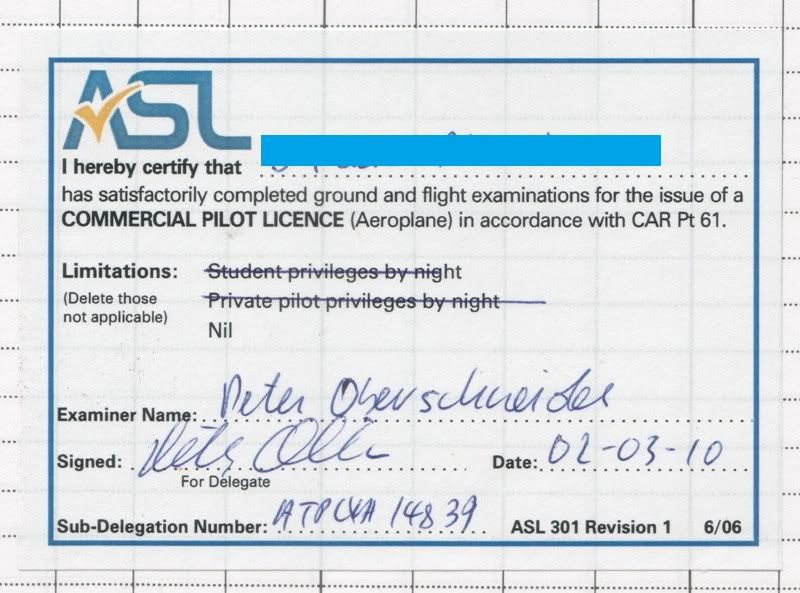
After the minor setback at the end of January... and a "no-show" last week due to a mix-up at ASL, yesterday saw me once again in the crisp white shirt, tie and pants nervously pacing up and down at the flying club awaiting the flight examiner.

As is usually the case, the thing I was most concerned about was the weather. After weeks of glorious weather, I awoke to find ARFORs (Area Forecasts) and TAFs (Terminal Aerodrome Forecasts) predicting heavy rain showers and thunderstorms across the Auckland area in the afternoon... from 4pm. My test was booked to start at 3:30pm.

As is usually the case, I awoke nice and "late" at 7am... after a "restful" night of tossing and turning... and after having some breakfast and triple checking I had everything I needed (and almost forgetting my tie) I headed out to the club.

I spent some time prepping the briefing room, making sure I had everything ready and at hand... Up-to-date AIP Vol's 1&4, Logbook, License, PhotoID, Exam results + signed off KDR's, current charts, Calculator, Nav Computer, Pens/Pencils, note paper, custom Take-Off and Landing calculation sheets to make sure I didn't forget AC91-3 and Part 135 requirements, Aircraft Flight Manual, a big folder containing all the relevant Parts (91 & 135) and Advisory Circulars so I could look up anything I needed if required.

Then I made sure the aircraft was good to go... by going for a nice relaxing solo flight (remembering to take the Flight Manual with me!). No instructors to pester me, just me and JFY and a lovely clear morning with variable winds.

0.7 hours and several max-rate turns, basic stall, approach stall, wingdrop stall and steep gliding turns later I was back on the ground and ready for some lunch.

And then the waiting really began. The clouds were starting to look dark and ominous... the temperature and pressure started to drop like a PA28 on a glide approach and there was that "It's going to rain" feeling in the air...

I tried very hard (and failed) not to check the weather reports and rain radar every 5 minutes...

I even tried taking my mind off it by sitting in the back of an aircraft to act as ballast for one of the other club members doing an all up weight check in LMA... but all I could do was look at the clouds around the area while we were flying around the circuit :)

Just after 3pm... I put on my shirt and tie and waited for the examiner to show up. He arrived exactly at 3:30pm and we got started on the groundwork. Making sure all the relevant bits of paper were in order (Logbook, ID, exams etc) and then into the flight planning.

A "short hop to Thames" and some careful calculations later... and some (very) random questions later, I had ticked all the groundwork boxes and it was time for the flying.

Pre-flight completed, aircraft fueled, we hopped in and I started running through my checks. I was really starting to feel nervous, right up until the engine kicked into life... and then I was in my comfort zone.

We taxied out, run-ups, max performance take-off and then headed south towards the training area. Then we started running through the syllabus...

I was feeling good and flying well (not perfect, but well within limits) and then came the words I had been quietly dreading... "Demonstrate a Max-Rate Turn to the right"...

Deep breaths... prominent reference point + heading, reference altitude... deep breath... Good lookup... airspeed below Va, lead with power... roll into the turn... increase back pressure... hitting 60degrees angle of bank... stall warning chirping away... maintaining altitude with ailerons... anticipate roll out... check forward and reduce power to prevent ballooning...

"Ok... now demonstrate one to the left"...

Repeat procedure... I thought it was a little messy at the end, and I could have used a little bit more rudder when rolling out to maintain balance and I commented as much to the examiner and asked if he would like me to demonstrate again...

"No, that's fine... when you're ready, demonstrate a basic stall"...

WOOOOOOOOOOHOOOOOOOOOOOOOOO!!!!!

We ran through the stalls, forced landing, precautionary landing, low flying, coastal reversal turn, constant radius turn...

"Ok, let's head back and you can demonstrate a flapless landing"

Back into the circuit following a near perfect overhead join... and slotting myself into a 3 aircraft train of Ardmore flying school aircraft, we started the circuits and finished with a shortfield landing onto the grass... I landed about 2 metres from my target aiming point and we pulled up with moderate braking about 1/3 of the way along the grass runway...

"Very nice landing"...

I taxied back to the club, shutdown and secured the aircraft... and we went inside for the debrief.

He held me in suspense for all of about 10 seconds before flashing me a big grin and offering me his hand to say congratulations...

We then covered the flight and he made a couple of comments, just some minor things to be aware of... nothing major and everything well within limits. We completed some paperwork and he congratulated me again and I went and opened my tab at the bar ;)


I'm still smiling, despite the minor hangover, and I don't expect this silly grin to wear off for at least another couple of days...

Next on the list: Multi-Engine Instrument Rating, Instructor Rating, Basic Gas Turbine Rating...


These Flights: 0.7 + 1.7 PinC (0.3 IFR)
Total Hours: 263.8 (136.5/103.0 Day, 8.6/15.7 Night, 11.9 IFR)

ps. If you know of anyone looking to hire a pilot... I'd appreciate it if you could point them in my direction ;)

Monday, 1 February 2010

2 more years...

I awoke to dark grey and wet. So that would make it Auckland Anniversary Day then ;)

However, by late morning, the steady drizzle had all but disappeared, the cloud base had started to increase and even small patches of blue were occassionally sneaking through the light white/grey cloud cover.

I headed out to the club after lunch ready for my booking with CFI Rob. My last BFR (actually my PPL flight test) was 03 February 2008. Meaning my Biennial Flight Review (BFR) was due on 03 February 2010. I had been hoping to avoid having to do one, by (successfully) completing a CPL flight test before that date. Unfortunately, we all know how that turned out. :( And having a 'current' PPL is a requirement for a CPL Flight Test.

So today was BFR with Rob day... including of course, some Max Rate Turns (which aren't even in the PPL syllabus ;)

Thankfully, this was not as stressful as it can be for some PPL Pilots. Mainly because almost every training flight I have done in the last 2 or 3 months has been close to a complete run through the CPL Training Syllabus which has somewhat stricter limits on flight maneuvers (eg. +/- 50' instead of +/- 100') and has a few more of them to boot. Also, one thing that Rob likes to stress is to ensure that the 'basic' maneuvers like medium, steep and compass turns are not 'overlooked' and practised regularly as they can (and have) bitten people on CPL flight tests!

After the flight, filling in the paper-work, I dutifully calculated my hours since the last 'BFR'. 160.2 hours in 2 years. Not too shabby for a "self-funded" operation...

And a memorable way to bring up 250 hours Total Time :D


This Flight: 1.0 Dual
Total Hours: 250.2 (127.2/98.7 Day, 8.6/15.7 Night, 11.0 IFR)

Wednesday, 4 November 2009

Committed

So I have finished up at work... FREEEEEEEEEEDOMMMMM!

And I have dealt with other things that required my attention, such as being best man at my friends wedding. And my bank balance is looking healthy thanks to my severance package and the weather, while less than brilliant has been very flyable.

All of which means I went and got my Class 1 Medical renewed on Monday (no major issues, yay!) and I've spent the last two days being assessed by CFI Rob as to where I currently am flying-wise, and what we'll need to do to get me to CPL Flight Test Standard.

Yesterday was just over an hour of cloud and shower dodging, while trying to demonstrate compass turns, steep turns, stalling in the turn, Forced Landings, Low Flying in the bad weather config, Coastal Reversal Turns and a nice Overhead Join with a shortfield grass landing to finish.

Today looked like it was going to be a washout, but I could almost have got sunburnt this afternoon, as the drizzle and low cloud gave way to blue skies and sunshine! So it was more steep turns, Max Rate Turns, Forced Landings, more low flying and coastal reversal turns, Steep Gliding Turns, a flapless landing and another shortfield landing onto the grass.

The upshot of all this (aside from being about $600 poorer) is that Rob thinks I am around 10 to 15 hours away from a CPL Flight Test. Which is better than I thought, bearing in mind that I had not been in an aircraft for about 2 months and had certainly not done any "proper" flight training for almost 3, I figured I was probably going to be a little underdone.

As expected my forced landings were a little rusty... the flying is not a problem, it is the rest of the procedure (initial actions, trouble checks, mayday call, passenger brief etc) that I get mixed up with. But this is really just a practice thing.

Most other things I am relatively competent at, I just need to polish them up a little to get them to a CPL standard. As Rob is fond of saying "Attention to Detail".

I am under no illusions that the next few weeks/months are going to be a lot of hardwork, but I'm up for it. So, I have more flights booked up for the rest of this week. Fingers crossed the weather holds ;)


These Flights: 1.1 Dual + 1.3 Dual
Total Hours: 219.2 (101.3/93.6 Day, 8.6/15.7 Night, 7.7 IFR)

Monday, 24 August 2009

When you least expect it...

Saturday morning saw me drag my butt out of bed at ridiculous o'clock to drive down to Hamilton for a sim session with Trevor (and the promise of a ride in the back of the Twin Comanche, DOK)...

In typical fashion, the only thing that occurred according to plan was that we drove to Hamilton and back :P

It turned out that the twin was booked most of the day by someone else. So John, Trevor's Instructor, decided we would do a quick session in the Sim and then we would take the nice "new" Archer III, WIT, for a ride so Trevor could familiarise himself with the cockpit instruments as it has the same "glass" instruments as the Twin Comanche.

While we were at it, John decided Trevor would fly us Matamata and they'd play with all the fancy pants equipment like the 3-axis autopilot, dual Garmin 430's and the Aspen Avionics EFD1000, then we'd swap over and I could take him for some circuits and do some stalls and a forced landing etc. on the way back to Hamilton and thus get "checked to line" for Waikato Aero Club purposes.

So my cruisy day of sitting in the sim and the backseat watching proceedings quickly turned into a $200+ mini-checkride :-/

So while Trevor and John finished up in the sim, I went out and pre-flighted WIT.
There are more excellent photo's that Chris has taken over on his blog here and here. Note that these pics were taken before the avionics upgrade. You can see a demo of the Aspen EFD1000 here.

The aircraft is still in pretty good nick... it even has that nice "new car leather" smell... Ooooo Shiny! ;) My only complaints are that there isn't enough room in the back (I couldn't wear my normal headset as I simply didn't have enough headroom!! So I had to resort to my homemade headset that wraps around the back) and because of the auto-pilot, the controls are quite "heavy" as the controls are all run through servo's. Other than that, the machine is a real dream!

The "check-ride" actually went pretty well... although due to an impromptu airshow being conducted at Matamata by a homebuilt scaled-down Fockewolfe FW-190, ZK-FWI our plan for circuits ended up being the stalling and forced landing component of the ride which went pretty well, although I got a little wide on the forced landing due to the longer wing on WIT compared with LMA, so my visual references using the wing-tip to judge spacing was a bit out. To my credit I did pick up on it and corrected it as best I could.

We came back and landed at Matamata to pick up Trevor and then headed back to Hamilton to finish up for the day and head back to Auckland.

So, not quite the day we had planned, but I think it turned out pretty well... and I have finally flown an aircraft that is actually younger than I am! It's a 2004 model with around 420hours TT ;)

Sunday, I came crashing back down to "reality" as I went and did some simulated IFR and forced landing practise in one of Airline Flying Club's C-152's :( Actually, to be fair, they're pretty tidy, and fun, little aircraft... and cheaper too ;)

The IFR was OK and I did a fairly decent job with the Partial Panel work. The forced landings were a little poor, I keep getting fixated on finding a field to land in before actually running through the procedures and checks, the end result being that I get everything mixed up and it just makes things really messy.

I thought I was doing pretty well with the glide approach onto the grass until Trevor suggested I use more flaps than I thought was necessary... the end result being that we came up "a little short", and I got a first-hand lesson on just how much you can steepen an approach using flaps... and why you should never extend downwind when doing glide approaches/forced landings!


These Flights: 0.9 Dual + 1.1 Dual (0.3 IFR)
Total Hours: 216.0 (98.9/92.8 Day, 8.6/15.7 Night, 7.7 IFR)

Tuesday, 18 August 2009

Glide time...

Glide Approaches that is.

The purpose of the glide approach is to practice the last part of the forced landing. ie. everything that happens after you hit your 1000' point abeam your 1/3 aiming point in your paddock/field/road/clearing/beach etc. Basically, as you come abeam the aiming point, you pull the power back to idle and glide the aircraft down onto the ground as if you were carrying out a forced landing. It's just that in this instance, instead of pretending to land in Farmer Joe's paddock, you land it on the runway :)

This is excellent practice, because when doing forced landing practice out in the training area, aiming for a paddock, you usually get to 500' (if solo) and say "yeah, I would get that in from here"... but you never really know for sure. Doing glide approaches, you definitely find out.

Sunday was looking a bit iffy weather-wise, but as we were planning on remaining in the circuit I was pretty confident we would be OK.

As it turns out, the iffy weather was just what I needed, as it kept everyone else on the ground meaning I had the entire circuit pretty much all to myself, making it relatively easy to get some decent glide approach practise without having to slot in amongst guys flying battleship sized circuits.

Along with the light showers and relatively low cloud base, we also had 25kt winds at circuit altitude. It was "only" 14kts gusting 20-ish on the ground, and being 20 to 30 degrees off centre meant a nice 5 to 10kt crosswind component to deal with.

Things happen quite quickly when a 25kt tailwind is increasing your normal ground speed by a 1/4! Turn downwind, make radio call, do downwind checks, initiate glide approach. Doesn't sound like it would be too difficult, until you only get about 5 seconds to do all of it!! :-/

Was quite challenging, but good fun... and unfortunately cut a little short due to approaching "bad" weather. Still, I got a good look at the effects of various techniques used to ensure you make your field... ie. making allowances for strong headwinds and turning a little tighter so as not to get blown too far downwind, carrying extra speed to get better forward penetration, losing altitude faster initially to get out of higher winds sooner, not using flaps until completely sure you're going to make the field etc.

The good news is that I "made" every approach and I think I have a much better appreciation for the approach profile that I should be aiming for when doing practice forced landings.


This Flight: 0.6 Dual
Total Hours: 214.0 (96.9/92.8 Day, 8.6/15.7 Night, 7.4 IFR)